Market Street Bridge, Chattanooga, TN: Location, Length, Height, Toll, History & Facts
Market Street Bridge had the longest rolling-lift bascule span in the world when it was completed in 1917. Its 300-foot center section is made of two steel leaves that roll back and tilt up to let tall boats pass on the Tennessee River. The bridge’s official name is the Chief John Ross Bridge, honoring the Cherokee leader whose trading post and landing gave Chattanooga its start. Graceful concrete arches flank the steel lift span as it carries North Market Street between downtown, near the Tennessee Aquarium, and the North Shore. It’s a working bridge for cars, walkers and cyclists, and it’s free to cross.
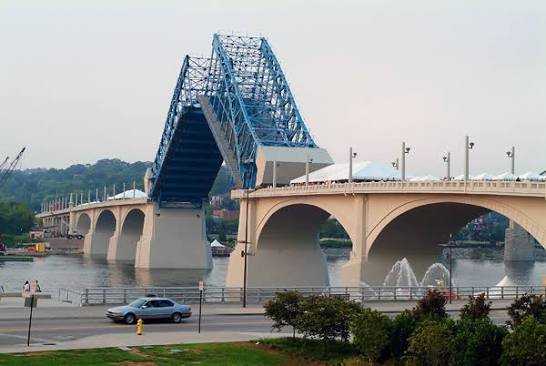
Market Street Bridge Key Facts
| Detail | Information |
| Official name | Chief John Ross Bridge (renamed in 1950) |
| Common name | Market Street Bridge |
| Location | Tennessee River, between downtown Chattanooga (near Ross’s Landing and the Tennessee Aquarium) and the North Shore, Chattanooga, Tennessee |
| Coordinates | Approx. 35.0590° N, 85.3090° W |
| Road | North Market Street (formerly US Route 127) |
| Bridge type | Double-leaf Scherzer rolling-lift bascule, with concrete arch approach spans |
| Chief engineer | Edwin Thacher (according to a plaque on the bridge) |
| Substructure builder | Neeley, Smith and Company of Chattanooga |
| Completed | 1917 |
| Original cost | About $1.1 million |
| Total length | About 1,894.5 ft (577 m) |
| Main (bascule) span | 300 ft (91 m) |
| Height of lift span | About 70 ft above the water |
| Lanes | 4 |
| Pedestrians | Sidewalks |
| World record | Longest rolling-lift bascule span in the world when completed (1917) |
| Renovation | Closed in 2005, reopened August 4, 2007 |
| Historic status | National Register of Historic Places (December 20, 2010) |
| Toll | None |
| Time zone | Eastern Time: UTC−5 (EST), UTC−4 (EDT, second Sunday in March to first Sunday in November) |
In the Heart of the Riverfront
The Market Street Bridge crosses the Tennessee River right in the middle of downtown Chattanooga. On the south side, it lands near Ross’s Landing, the riverfront park beside the Tennessee Aquarium, where Market Street continues into downtown. On the north side, it reaches the North Shore at Frazier Avenue, home to shops, cafés, Coolidge Park and Renaissance Park.
The bridge sits just downstream from the Walnut Street Bridge. The two together make an easy loop: walk over one bridge and back on the other to see the riverfront from both sides.
How the Rolling Lift Works
The Market Street Bridge combines two very different designs:
- Concrete arch spans on each side give the bridge its graceful, classical look along the approaches.
- A steel truss center span opens to let river traffic through. This 300-foot section is a double-leaf Scherzer rolling-lift bascule.
On a Scherzer rolling-lift bridge, each leaf rests on curved steel segments that roll backward along a track as the leaf tilts up, like a rocking chair rocking back. This design shifts the leaf’s weight away from the channel as it opens, giving boats more room. When the Market Street Bridge was finished in 1917, its 300-foot main span was the longest rolling-lift bascule span anywhere in the world.
Other key numbers:
- The total length of the bridge is about 1,894.5 feet.
- The lift span sits about 70 feet above the water, high enough for most river traffic to pass without an opening.
- The bridge carries four lanes of traffic, with sidewalks for pedestrians.
Free to Cross
There’s no toll on the Market Street Bridge. Tips for visiting:
- Drivers use four lanes of North Market Street between downtown and the North Shore.
- Pedestrians can use the sidewalks, which offer great views of the river, the Walnut Street Bridge and Lookout Mountain.
- Cyclists can ride with traffic or walk their bikes on the sidewalk.
- A few times a year, the bridge closes briefly so the lift span can be tested, as required by the U.S. Coast Guard. Check city notices for closure dates.
Building the Bridge
By the early 1900s, Chattanooga was growing quickly, and the Walnut Street Bridge alone couldn’t handle all the traffic between downtown and the north bank. The city planned a new bridge at Market Street, the main north–south street through downtown.
Because the Tennessee River was an important shipping route, the new bridge needed a movable span so steamboats and barges could pass. Engineers chose the Scherzer rolling-lift design, which was then becoming popular for movable bridges in cities like Chicago. The local firm Neeley, Smith and Company built the foundations and piers, and the bridge was completed in 1917 at a cost of about $1.1 million.
From the start, the bridge carried streetcars along with cars and wagons. Streetcar service across it ended in the 1930s. For many years the bridge was part of US Route 127, until the highway’s southern end was moved north in the mid-1970s.
Who Was Chief John Ross?
In 1950, the bridge was formally renamed in honor of Chief John Ross. Ross served as Principal Chief of the Cherokee Nation for nearly 40 years, from 1828 until his death in 1866, and was known as a skilled leader and diplomat.
Ross also played a key part in Chattanooga’s early history. Around 1816, he set up a trading post and ferry landing on the south bank of the Tennessee River. The settlement that grew around it was known as Ross’s Landing, and it later became the city of Chattanooga. Today, Ross’s Landing is a riverfront park at the south end of the bridge, beside the Tennessee Aquarium.
Restoration and Recognition
In 2005, the bridge closed for a major renovation to restore its structure and update its machinery. The work finished ahead of schedule, and the bridge reopened on August 4, 2007, a month earlier than planned. On December 20, 2010, the bridge was listed on the National Register of Historic Places, recognizing its engineering and its place in Chattanooga’s history.
Things to Do Nearby
- The Tennessee Aquarium, near the south end of the bridge, is one of the city’s top attractions.
- Ross’s Landing, the riverfront park where Chattanooga began, has lawns, walkways and public art.
- Coolidge Park and Renaissance Park on the North Shore have open lawns, a carousel and river views.
- Frazier Avenue on the North Shore is lined with shops, restaurants and coffee houses.
- The Walnut Street Bridge, just upstream, is one of the longest pedestrian bridges in the world.
FAQs
Q1. Is there a toll on the Market Street Bridge?
No. The Market Street Bridge is free for drivers, pedestrians and cyclists.
Q2. What is the official name of the Market Street Bridge?
It’s officially called the Chief John Ross Bridge, a name it received in 1950.
Q3. How long is the Market Street Bridge?
It’s about 1,894.5 feet long, with a 300-foot main span.
Q4. How high is the Market Street Bridge?
The lift span sits about 70 feet above the Tennessee River.
Q5. When was the Market Street Bridge built?
It was completed in 1917.
Q6. What type of bridge is the Market Street Bridge?
It’s a double-leaf Scherzer rolling-lift bascule bridge with concrete arch approach spans.
Q7. Was the Market Street Bridge ever a world record?
Yes. When completed in 1917, its 300-foot main span was the longest rolling-lift bascule span in the world.
Q8. Can you walk across the Market Street Bridge?
Yes. The bridge has sidewalks for pedestrians.
Q9. Who was Chief John Ross?
He was Principal Chief of the Cherokee Nation from 1828 to 1866, and his trading post at Ross’s Landing grew into the city of Chattanooga.
Q10. What is near the Market Street Bridge?
The Tennessee Aquarium, Ross’s Landing, Coolidge Park and the Walnut Street Bridge are all close by.



Post Comment