Pennybacker Bridge, Austin, TX: Location, Length, Height, Toll, History & Facts
Pennybacker Bridge never touches the water beneath it. Its rust-colored steel arch springs straight from the limestone cliffs on either side of Lake Austin, so boaters and water-skiers have a clear path underneath. Most Austinites call it simply the “360 Bridge,” after Loop 360, the scenic Capital of Texas Highway it carries. It opened on December 3, 1982, and was then only the second bridge of its kind in the world. The view from the rocky overlook just north of the bridge, with the arch, the lake, the Hill Country and the downtown skyline, is one of the most photographed scenes in Texas. The bridge is free to cross.
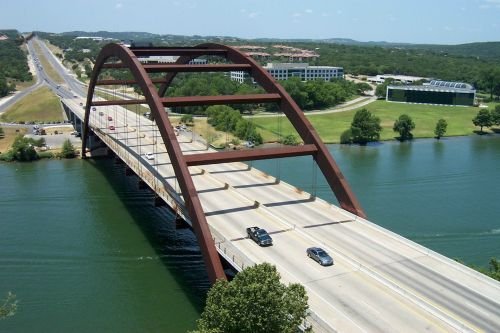
Pennybacker Bridge Key Facts
| Detail | Information |
| Official name | Percy V. Pennybacker Jr. Bridge |
| Common name | 360 Bridge |
| Location | Lake Austin (Colorado River), on Loop 360 in west Austin, Texas |
| Coordinates | Approx. 30.3510° N, 97.7980° W |
| Highway | Loop 360 (Capital of Texas Highway) |
| Owner | Texas Department of Transportation (TxDOT) |
| Bridge type | Steel through-arch bridge with a suspended deck |
| Contractor | Clearwater Constructors of Denver, Colorado |
| Construction | Contract awarded late 1979; steel erection completed July 1982 |
| Dedicated | November 29, 1982 |
| Opened to traffic | December 3, 1982 |
| Construction cost | About $10 million |
| Total length | About 1,150 ft (351 m) |
| Main span | About 600 ft (183 m) |
| Height above the water | About 100 ft |
| Width | About 87 ft |
| Lanes | 4 |
| Support cables | 72 steel cables |
| Material | Weathering steel, which forms a protective rust-colored finish |
| Distinction | Only the second bridge of its type in the world when completed; no part touches the water |
| Awards | 1984 FHWA Excellence in Highway Design award; named most innovative local architecture by Austin engineers in 1992 |
| Named for | Percy V. Pennybacker Jr., Texas Highway Department bridge engineer |
| Toll | None |
| Time zone | Central Time: UTC−6 (CST), UTC−5 (CDT, second Sunday in March to first Sunday in November) |
In the Hills West of Downtown
The Pennybacker Bridge crosses Lake Austin in the wooded hills of west Austin, about 10 miles from downtown. Lake Austin is a long, narrow reservoir on the Colorado River, lined with limestone bluffs, waterfront homes and boat docks.
The bridge carries Loop 360, the Capital of Texas Highway, a scenic road that winds through the hills on Austin’s west side. On the north end, it leads toward the Northwest Hills neighborhood and US 183. On the south end, it heads toward Westlake and MoPac. Despite its name, Loop 360 isn’t actually a full loop, but it’s one of the most beautiful drives in the city.
An Arch That Floats Over the Lake
The Pennybacker Bridge is a steel through-arch bridge. The roadway runs between the base and the top of the arch, hanging from cables above.
- The bridge is about 1,150 feet long, with a central arch span of about 600 feet.
- The deck sits about 100 feet above Lake Austin.
- The bridge is about 87 feet wide and carries four lanes of traffic.
- Two sweeping steel arches, linked by rectangular steel struts, rise above the roadway.
- The deck hangs from 72 steel cables attached to the arches.
- No part of the bridge touches the water. The arch is anchored into the rock cliffs on each side.
The bridge was first planned with piers in the lake, but in 1978 it was redesigned to keep the water completely clear. That decision protected the lake for boating, fishing and water-skiing, and it gave the bridge its distinctive floating look.
Why It’s Rust-Colored
The bridge’s warm reddish-brown color comes from weathering steel, often known by the brand name COR-TEN. This type of steel forms a stable layer of rust on its surface, which protects the metal underneath and means the bridge never needs painting.
Before the bridge was dedicated, the steel was sandblasted so it would weather evenly. Within a few years, it had settled into the amber-brown shade that blends so naturally with the surrounding hills and cliffs. The name “Pennybacker” isn’t a reference to its penny-like color, though. It honors a person.
Free to Cross
There’s no toll on the Pennybacker Bridge. Tips for visiting:
- Drivers use four lanes of Loop 360, with sweeping views of Lake Austin and the Hill Country.
- Rush-hour traffic on Loop 360 can be heavy, so plan extra time on weekdays.
- Don’t stop on the bridge for photos. Use the overlook parking area just north of the bridge instead.
- Boaters, kayakers and paddleboarders on Lake Austin can pass beneath the bridge for a dramatic view of the arch from below.
Building the 360 Bridge
As Austin grew in the 1970s, the city needed a better way to connect its northwest and southwest neighborhoods across Lake Austin. The Texas Highway Department planned a bridge for Loop 360 that would protect the area’s natural beauty.
“We chose a bridge design that would enhance the beauty of the entire area and have as little environmental impact as possible,” a highway department official said at the time of construction.
The construction contract went to Clearwater Constructors of Denver in late 1979. Steel erection was completed in July 1982. Austin Mayor Carole McClellan and other officials dedicated the bridge on November 29, 1982, and it opened to traffic on December 3, 1982, at a cost of about $10 million.
Who Was Percy Pennybacker?
Percy V. Pennybacker Jr. was a bridge engineer for the Texas Highway Department around the time of World War II. He was a pioneer in using welding to build steel bridges, a technique that made construction more efficient and cost-effective. The Loop 360 bridge was named in his honor, recognizing his contributions to bridge engineering in Texas.
Awards and Recognition
The Pennybacker Bridge has earned praise from engineers and designers:
- In 1984, it received the Federal Highway Administration’s Excellence in Highway Design award.
- In 1992, the Austin members of the Consulting Engineers Council of Texas named it the most innovative example of local architecture.
The 360 Overlook
Just north of the bridge, on the west side of Loop 360, a short but steep scramble up rocky limestone ledges leads to the famous 360 Overlook. From the top, visitors see the bridge’s arch framed by Lake Austin, the green Hill Country and the downtown skyline in the distance. It’s especially popular at sunrise and sunset, and many Austinites consider it a must-see.
Tips for the overlook:
- Wear sturdy shoes, since the climb is over uneven rock.
- Bring water, especially in summer.
- Parking is limited along the roadside, so arrive early on weekends.
- Stay on established paths and take your trash with you.
Things to Do Nearby
- The 360 Overlook, just north of the bridge, has one of the best views in Austin.
- Lake Austin is perfect for boating, kayaking and paddleboarding beneath the bridge.
- Mount Bonnell, a few miles south, is another classic Austin lookout over Lake Austin.
- Emma Long Metropolitan Park, upstream on Lake Austin, has a beach, camping and trails.
- Downtown Austin, about 20 minutes away, has the Texas State Capitol and the Congress Avenue Bridge bat colony.
FAQs
Q1. Is there a toll on the Pennybacker Bridge?
A. No. The Pennybacker Bridge is free to cross.
Q2. Why is it called the 360 Bridge?
A. It carries Loop 360, the Capital of Texas Highway, across Lake Austin.
Q3. How long is the Pennybacker Bridge?
A. It’s about 1,150 feet long, with a main arch span of about 600 feet.
Q4. How high is the Pennybacker Bridge?
A. The deck sits about 100 feet above Lake Austin.
Q5. When was the Pennybacker Bridge built?
A. It was dedicated on November 29, 1982, and opened to traffic on December 3, 1982.
Q6. Does the Pennybacker Bridge touch the water?
A. No. The bridge is anchored into the cliffs on each side, so no part of it touches Lake Austin.
Q7. Why is the Pennybacker Bridge rusty?
A. It’s made of weathering steel, which forms a protective rust-colored layer and never needs painting.
Q8. Who was the Pennybacker Bridge named after?
A. It’s named for Percy V. Pennybacker Jr., a Texas Highway Department engineer who pioneered welded steel bridges.
Q9. Where is the best view of the Pennybacker Bridge?
A. The 360 Overlook, a rocky lookout just north of the bridge, has the most famous view.
Q10. Did the Pennybacker Bridge win any awards?
A. Yes. It won the 1984 Federal Highway Administration’s Excellence in Highway Design award.




Post Comment