Peace Bridge, Buffalo, NY: Location, Length, Height, Toll, History & Facts
Peace Bridge turns 100 in 2027. It’s one of the few border crossings built to celebrate a friendship. It crosses the Niagara River where the river flows out of Lake Erie, linking Buffalo, New York with Fort Erie, Ontario. It’s named for the century of peace between the United States and Canada that followed the War of 1812. The bridge opened to the public on June 1, 1927, and was formally dedicated that August by a crowd of statesmen, including the Prince of Wales and the Vice President of the United States. Today it’s one of the busiest crossings on the northern border. Cars pay a toll only when heading into Canada, and just $4 with E-ZPass.
Peace Bridge Facts
| Detail | Information |
| Location | Niagara River at the outlet of Lake Erie, between Buffalo, New York (USA) and Fort Erie, Ontario (Canada) |
| Coordinates | Approx. 42.9069° N, 78.9056° W |
| Operator | Buffalo and Fort Erie Public Bridge Authority (Peace Bridge Authority) |
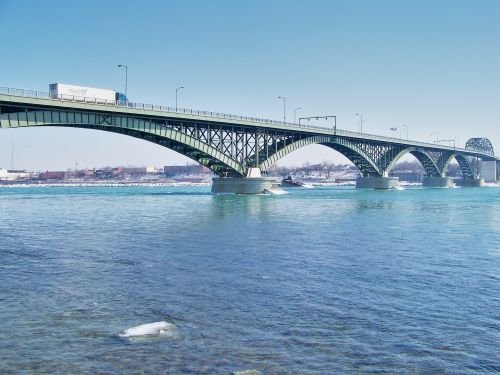
| Bridge type | Five steel deck arches over the Niagara River plus a Parker truss over the Black Rock Canal |
| Chief engineer | Edward Lupfer |
| Approved | August 6, 1925, by the International Joint Commission |
| Construction | 1925–1927 |
| First car across | March 13, 1927 (driven by Edward Lupfer) |
| Opened to the public | June 1, 1927 |
| Official dedication | August 7, 1927 |
| Total length | 5,800 ft (1.77 km) |
| Bridge structure | About 3,580 ft |
| Longest span | About 130 m (427 ft) |
| Height | Low-level design, with arches beneath the roadway. The Parker truss over the Black Rock Canal is the only part that rises above the deck |
| Steel used | About 9,000 tons of structural steel |
| Lanes | 3 reversible lanes |
| Road connections | I-190 (exit 9) in Buffalo; Queen Elizabeth Way in Fort Erie |
| Toll direction | Canada-bound only |
| Car toll: E-ZPass | $4.00 USD |
| Car toll: credit/debit card | $8.00 USD or $11.00 CAD |
| Pedestrians and cyclists | Allowed; no toll |
| Commercial trucks | Allowed |
| Bridge lighting | About 700 color LED fixtures, installed in 2009 |
| Travel documents | Passport, passport card, NEXUS card, Enhanced Driver’s License or other accepted document |
| Time zone | Eastern Time: UTC−5 (EST), UTC−4 (EDT, second Sunday in March to first Sunday in November) |
Where Lake Erie Becomes the Niagara River
The Peace Bridge stands at the very start of the Niagara River, just downstream from where Lake Erie begins emptying toward Niagara Falls, about 12 miles away. On the Buffalo side, the bridge lands near Front Park and the Columbus Park–Prospect Hill neighborhood, close to downtown and the waterfront. On the Canadian side, it touches down in Fort Erie, a short drive from Old Fort Erie and the Niagara Parkway.
For drivers, the bridge is a key link between the US interstate system and Ontario’s highways. I-190 feeds directly onto it in Buffalo. The Queen Elizabeth Way, which continues toward Niagara Falls, Hamilton and Toronto, begins at the Canadian end.
Five Arches and a Truss
The bridge is built as a row of five graceful steel arches that carry the roadway across the Niagara River, plus a Parker truss that spans the Black Rock Canal on the American side. That truss is the steel frame you’ll see rising above the deck near the Buffalo end, and it’s the easiest way to recognize the bridge from a distance.
- The whole crossing is 5,800 feet long, a little over a mile, including approaches.
- The steel structure itself measures about 3,580 feet.
- The longest arch span is about 130 meters, roughly 427 feet.
- Building it took about 9,000 tons of structural steel and 800 tons of reinforcing steel in the concrete abutments.
The biggest engineering challenge was the river itself. At this point the Niagara is fast, with currents averaging 7.5 to 12 miles per hour. Chief engineer Edward Lupfer’s crews had to build the piers in some of the swiftest water on the river, and they finished the job in about two years.
Paying the Toll
Tolls are collected only on the Canadian side, after vehicles clear Canadian customs. There’s no toll when entering the United States.
| Payment method | Passenger car toll |
| E-ZPass | $4.00 USD |
| Credit or debit card | $8.00 USD or $11.00 CAD |
- E-ZPass cuts the toll in half. The Peace Bridge became the first E-ZPass facility outside the United States in 2002.
- The toll lanes are cashless and self-service. Drivers without E-ZPass simply tap a credit or debit card.
- Pedestrians and cyclists cross for free.
- Unlike the Rainbow Bridge, the Peace Bridge allows commercial trucks. It’s one of the busiest truck crossings on the US–Canada border.
A Bridge Built to Mark a Century of Peace
Before the Peace Bridge, the only way across the river here was the International Railway Bridge, built in 1873 for trains. As cars became common in the 1910s and 1920s, Buffalo and Fort Erie needed a road bridge. The International Joint Commission approved the project in 1925. Construction started that year and finished in the spring of 1927.
Lupfer drove the first car across on March 13, 1927, and the bridge opened to the public on June 1. The official dedication came on August 7, 1927, and drew about 20,000 people. The guest list was remarkable: the Prince of Wales (the future Edward VIII) and his brother Prince George, British Prime Minister Stanley Baldwin, Canadian Prime Minister William Lyon Mackenzie King, US Vice President Charles Dawes, Secretary of State Frank Kellogg, New York Governor Al Smith and Ontario Premier Howard Ferguson.
The ceremony was broadcast by radio in what was billed as the first international coast-to-coast broadcast. Newspapers at the time estimated that tens of millions of people may have tuned in. A local composer even wrote a “Peace Bridge March” for the occasion.
Crossing the Border
The Peace Bridge is a full international crossing, with customs and immigration plazas at both ends:
- Everyone needs an accepted travel document, such as a passport, passport card, NEXUS card or Enhanced Driver’s License. Check the current US and Canadian entry rules before you go.
- NEXUS members have dedicated lanes, which can save a lot of time at busy periods.
- The Canadian inspection plaza, completed in 2010, has 14 car lanes and a separate truck area.
- Pedestrians and cyclists are processed in their own areas at each plaza.
- The Peace Bridge Authority posts wait times online. Weekends, holidays and summer afternoons are usually the busiest.
Lighting Up the Night
Buffalo was once called the “City of Light,” as one of the first cities powered by hydroelectricity from Niagara Falls. The Peace Bridge carries on that tradition. In 2009, the Peace Bridge Authority installed nearly 700 color LED fixtures that light the arches from below. Each hour, the system runs a light show, then settles into a color scheme. Special colors mark holidays, local sports teams and community events. The new lights also use far less energy than the old floodlights.
Where to See It
- LaSalle Park and the waterfront trail in Buffalo give a wide view of the bridge’s arches with Lake Erie behind them.
- Front Park, near the Buffalo end, looks down on the bridge and the river.
- On the Canadian side, the Niagara River Recreation Trail and the parks along the Fort Erie waterfront offer views back toward Buffalo’s skyline.
- Sunset over Lake Erie, framed by the lit-up arches, is especially popular with photographers.
A Few More Facts
- When the bridge opened, it was the only vehicular bridge between the Great Lakes region and New York on this part of the border. Buffalo and Fort Erie each became the main port of entry into their countries from the other.
- For the bridge’s 50th anniversary in 1977, Canada Post and the US Postal Service issued a joint set of postage stamps. The two countries used very different designs.
- The Peace Bridge Authority is run by a ten-member board, five members from each country, with the chairmanship alternating each year between a Canadian and an American.
- The bridge’s centennial in 2027 marks 100 years of continuous service linking the two countries.
FAQs
Q1. How much is the Peace Bridge toll?
Cars pay $4.00 USD with E-ZPass, or $8.00 USD / $11.00 CAD by credit or debit card.
Q2. Do you pay the Peace Bridge toll both ways?
No. The toll is charged only when heading into Canada, and entering the US is free.
Q3. Can you walk across the Peace Bridge?
Yes. Pedestrians and cyclists can cross for free, but they must go through customs with an accepted travel document.
Q4. How long is the Peace Bridge?
It’s 5,800 feet long in total, and the steel bridge structure is about 3,580 feet.
Q5. When was the Peace Bridge built?
Construction ran from 1925 to 1927. The bridge opened on June 1, 1927, and was dedicated on August 7, 1927.
Q6. Why is it called the Peace Bridge?
It was named to honor 100 years of peace between the United States and Canada following the War of 1812.
Q7. Does the Peace Bridge accept E-ZPass?
Yes. It became the first E-ZPass facility outside the United States in 2002.
Q8. Can trucks cross the Peace Bridge?
Yes. Commercial trucks are allowed, and it’s one of the busiest truck crossings on the US–Canada border.
Q9. What do I need to cross the Peace Bridge?
You’ll need a passport, passport card, NEXUS card, Enhanced Driver’s License or another accepted document.
Q10. Why does the Peace Bridge change colors at night?
About 700 LED fixtures installed in 2009 light the arches in changing colors for light shows, holidays and special events.



Post Comment