Smithfield Street Bridge, Pittsburgh, PA: Location, Length, Height, Toll, History & Facts
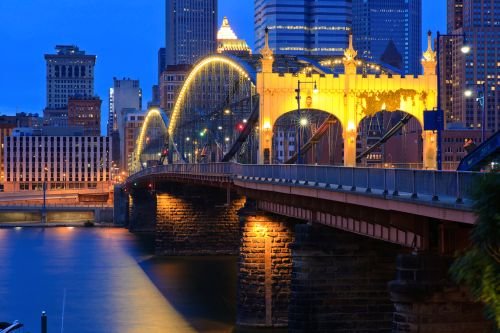
Smithfield Street Bridge is Pittsburgh’s oldest river bridge, and it looks like nothing else in the “City of Bridges.” Its two steel spans curve above and below the roadway in a lens shape. Engineers call this a lenticular truss, and from the side each span looks like a giant eye. Designed by Gustav Lindenthal when he was just 32, the bridge opened on March 19, 1883, and carries Smithfield Street across the Monongahela River from downtown to Station Square. It’s the oldest through-truss bridge in the United States and one of the first bridges in the country built mainly of steel. Crossing it has been free since 1911.
Smithfield Street Bridge Key Facts
| Detail | Information |
| Location | Monongahela River, between Smithfield Street in downtown Pittsburgh and Station Square on the South Side, Pittsburgh, Pennsylvania |
| Coordinates | Approx. 40.4350° N, 80.0010° W |
| Road | Smithfield Street (SR 3027) |
| Bridge type | Steel lenticular truss bridge (with some wrought-iron members) |
| Engineer | Gustav Lindenthal |
| Construction | 1881–1883 (piers begun in 1880) |
| Opened | March 19, 1883 |
| Main spans | Two, each 360 ft (110 m), with 344 ft of clear span |
| Total length | About 1,184 ft (361 m), including the longest elevated ramp |
| Deck height | About 42.5 ft above the river |
| Bridge number at the site | Third |
| Portals | Gothic Revival portals added in 1915, designed by Stanley Roush |
| Aluminum deck | 1933, the first use of structural aluminum in a bridge |
| Restoration | 1994–1995: new steel floor system, repainted in its 1915 colors and relit |
| Tolls removed | 1911 |
| Pedestrians | Sidewalks on both sides |
| Distinctions | Oldest through-truss bridge in the US; longest lenticular truss spans in the US; oldest river bridge in Allegheny County |
| Historic status | National Historic Landmark; National Historic Civil Engineering Landmark; National Register of Historic Places |
| Toll | None |
| Time zone | Eastern Time: UTC−5 (EST), UTC−4 (EDT, second Sunday in March to first Sunday in November) |
Downtown to Station Square
The Smithfield Street Bridge crosses the Monongahela River at the heart of downtown Pittsburgh. Its north end lands on Smithfield Street, one of downtown’s main streets, near Point Park University and the shopping and office district. Its south end lands at Station Square, a former railroad terminal complex that’s now home to restaurants, shops, a riverfront park and the Gateway Clipper riverboat fleet.
Right beside the bridge’s south end, the Monongahela Incline climbs the steep slope of Mount Washington. It’s one of the oldest working inclines in the country, and its upper station has some of the best views of the bridge and the downtown skyline.
The Lens-Shaped Spans
The bridge’s design is what makes it special. Each span is a lenticular truss, also called a Pauli truss: one steel chord arches upward, another curves downward, and the two meet at each end like the outline of a lens.
- The bridge has two main spans of 360 feet each, with 344 feet of clear distance between the piers.
- They are the longest lenticular truss spans ever built in the United States.
- Including the longest elevated approach ramp, the bridge is about 1,184 feet long.
- The deck sits about 42.5 feet above the Monongahela River.
The lenticular design worked a bit like a combination of an arch and a suspension bridge. It used many small pieces that were easy to manufacture, ship and assemble, which made it a practical choice for the time. Lindenthal originally planned to use Bessemer steel but switched to open-hearth steel made locally in Pittsburgh, because it could be produced with more consistent quality. That made the bridge a symbol of Pittsburgh’s rise as America’s steel capital.
Free to Cross
There’s no toll on the Smithfield Street Bridge today. When it first opened, it was a toll bridge, and the tolls were removed in 1911.
Tips for visiting:
- Drivers can cross between downtown and Station Square, with connections to Carson Street and the South Side.
- Pedestrians have sidewalks on both sides, and the walk across takes about five minutes.
- The sidewalks offer great views of the Pittsburgh skyline, the Monongahela River and Mount Washington.
- At night, the bridge is lit up, and its lens-shaped trusses glow over the river.
Three Bridges at One Crossing
The Smithfield Street Bridge stands on one of the oldest river crossings in Pittsburgh:
- 1818: The first bridge here, a wooden covered bridge designed by Lewis Wernwag, was likely the first bridge across any of Pittsburgh’s three rivers. It was lost in the Great Fire of 1845.
- 1846: John A. Roebling, who later designed the Brooklyn Bridge, built a wire rope suspension bridge on the earlier piers.
- 1880–1883: As traffic grew heavier, a new bridge was needed. Work began in 1880 under engineer Charles Davis, but Gustav Lindenthal soon took over and designed the lenticular truss bridge that stands today. It opened on March 19, 1883.
A Bridge That Kept Changing
The Smithfield Street Bridge has been updated many times to keep up with the city’s growth:
- 1889: A second deck was added to carry horse-drawn streetcars.
- 1899: The deck was widened to handle electric trolleys.
- 1911: The bridge was widened again and the tolls were removed.
- 1915: The original wrought-iron portals were replaced with Gothic Revival portals designed by Stanley Roush, which still stand at each end.
- 1933: The floor was rebuilt with structural aluminum, the first time aluminum was used structurally in a bridge. It cut the bridge’s dead weight by about 675 metric tons.
- 1967: A new aluminum deck reduced the weight even further.
- 1994–1995: A major restoration replaced the aluminum floor system with steel. The bridge was repainted in its 1915 colors and given new lighting.
About Gustav Lindenthal
Gustav Lindenthal was born in Austria in 1850 and came to the United States as a young engineer. The Smithfield Street Bridge was one of his first major works. He went on to become one of the most influential bridge engineers in American history, serving as New York City’s commissioner of bridges and designing the Queensboro Bridge and the Hell Gate Bridge. As commissioner, he made it standard practice for engineers and architects to collaborate on major bridges, an approach the graceful Smithfield Street Bridge helped inspire.
Things to Do Nearby
- The Monongahela Incline carries riders from Station Square up to Mount Washington, with stunning views of the bridge and city.
- Station Square has restaurants, shops, a riverfront park and the Gateway Clipper riverboat cruises.
- Mount Washington’s Grandview Avenue has overlooks often named among the best city views in the country.
- Point State Park, at the tip of downtown, marks where the Allegheny and Monongahela rivers meet to form the Ohio.
- The South Side Flats, just east of Station Square, is known for its restaurants, shops and nightlife.
FAQs
Q1. Is there a toll on the Smithfield Street Bridge?
A. No. Tolls were removed from the Smithfield Street Bridge in 1911, and it is now free to cross.
Q2. How long is the Smithfield Street Bridge?
A. The Smithfield Street Bridge is about 1,184 feet long, with two main spans measuring approximately 360 feet each.
Q3. How high is the Smithfield Street Bridge?
A. The bridge deck sits about 42.5 feet above the Monongahela River.
Q4. When was the Smithfield Street Bridge built?
A. The Smithfield Street Bridge was built between 1881 and 1883 and officially opened on March 19, 1883.
Q5. Who designed the Smithfield Street Bridge?
A. The bridge was designed by engineer Gustav Lindenthal, who later worked on major bridges in New York, including the Queensboro Bridge and Hell Gate Bridge.
Q6. What is a lenticular truss?
A. A lenticular truss is a bridge truss design with chords that curve upward and downward to form a lens-like shape. The design combines structural characteristics of an arch and a suspension bridge.
Q7. Is the Smithfield Street Bridge the oldest bridge in Pittsburgh?
A. Yes. It is the oldest river bridge in Allegheny County and is recognized as the oldest through-truss bridge in the United States.
Q8. Can you walk across the Smithfield Street Bridge?
A. Yes. The Smithfield Street Bridge has sidewalks on both sides, allowing pedestrians to walk across it.
Q9. What does the Smithfield Street Bridge connect?
A. The bridge crosses the Monongahela River and connects downtown Pittsburgh with Station Square on the South Side.
Q10. What was special about the bridge’s 1933 renovation?
A. The 1933 renovation added an aluminum deck to the Smithfield Street Bridge, marking the first use of structural aluminum in a bridge.





Post Comment