Woodrow Wilson Memorial Bridge, Washington, D.C.: Location, Length, Height, Toll, History & Facts
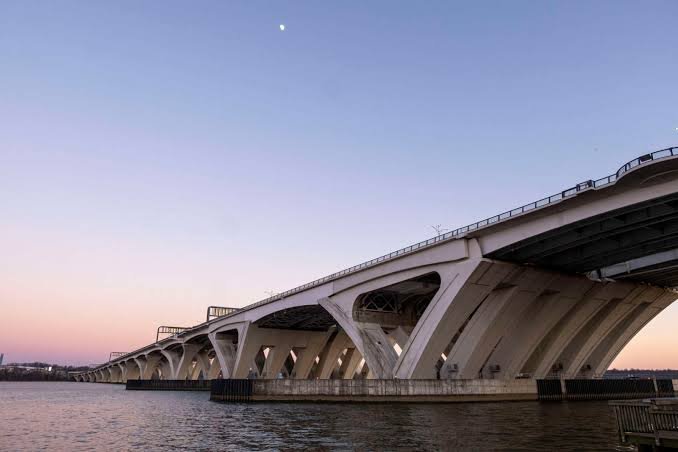
Woodrow Wilson Memorial Bridge is one of the few drawbridges anywhere on the U.S. Interstate Highway System, and Discovery Channel’s Extreme Engineering called it the world’s largest drawbridge. It carries I-95 and the I-495 Capital Beltway across the Potomac River between Alexandria, Virginia and Oxon Hill, Maryland, near National Harbor. Along the way, about 300 feet of the bridge crosses the southernmost tip of Washington, D.C. Today’s twin spans opened in 2006 and 2008, replacing a six-lane drawbridge from 1961 with 12 lanes and a walking and biking trail. The bridge carries roughly a quarter of a million vehicles a day, and it’s free to cross.
Woodrow Wilson Bridge Key Facts
| Detail | Information |
| Official name | Woodrow Wilson Memorial Bridge |
| Common name | Wilson Bridge |
| Location | Potomac River, between Alexandria, Virginia (Jones Point) and Oxon Hill, Maryland (near National Harbor), crossing the southern tip of Washington, D.C. |
| Coordinates | Approx. 38.7927° N, 77.0326° W |
| Highways | I-95 and I-495 (Capital Beltway) |
| Owners | Maryland and Virginia |
| Bridge type | Twin double-leaf bascule (drawbridge) spans with concrete approach spans |
| Bascule span designer | Hardesty & Hanover |
| First new span opened | June 10, 2006 |
| Second new span opened | May 30, 2008 |
| Original bridge | Opened December 28, 1961; removed 2006–2009 |
| Total length | About 6,736 ft (2,053 m) |
| Bascule span | About 270 ft between trunnions, with a channel about 175 ft wide |
| Clearance (closed) | About 70 ft above the water |
| Clearance (open) | Unlimited within the navigation channel |
| Lanes | 12 (8 through lanes, 2 merge lanes and 2 for future transit or HOV) |
| Daily traffic | Roughly 200,000–250,000 vehicles |
| Steel used | About 130 million lb |
| Trail | Woodrow Wilson Bridge Trail for walkers and cyclists, with overlooks |
| Named for | President Woodrow Wilson (renamed in 1956, his 100th birthday year) |
| Toll | None |
| Time zone | Eastern Time: UTC−5 (EST), UTC−4 (EDT, second Sunday in March to first Sunday in November) |
Three Jurisdictions in One Crossing
The Wilson Bridge is the only Potomac River crossing in the southern half of the Washington area. On the Virginia side, it starts at Jones Point in Alexandria, just south of the historic Old Town waterfront. On the Maryland side, it lands at Oxon Hill in Prince George’s County, right beside the National Harbor resort and entertainment district.
Because the D.C. boundary extends to the Virginia shore of the Potomac, about 300 feet of the bridge’s western midsection passes over the very southern tip of Washington, D.C. That means drivers crossing the Wilson Bridge pass through three jurisdictions in under two miles: Virginia, the District of Columbia and Maryland.
A Giant Drawbridge
The new Wilson Bridge is actually two side-by-side bridges, each carrying six lanes. At the center of each is a bascule span, a drawbridge with leaves that tilt upward to let tall ships through.
- Together, the twin bridges stretch about 6,736 feet, or roughly 1.3 miles.
- The four side-by-side bascule leaves pivot from trunnions about 270 feet apart, opening a navigation channel roughly 175 feet wide.
- When closed, the bridge gives boats about 70 feet of clearance, 20 feet more than the old bridge, so most vessels pass beneath without an opening.
- When open, the channel has unlimited vertical clearance.
- The bascule spans rest on distinctive delta-shaped concrete piers.
- Building the bridge took about 130 million pounds of steel.
The higher clearance cut the number of drawbridge openings dramatically, by about 75 percent compared with the old bridge. Openings are scheduled in advance, usually late at night when traffic is lightest.
Free to Cross
There’s no toll on the Woodrow Wilson Bridge. Tips for using it:
- The bridge is one of the busiest crossings in the region, so expect heavy traffic during rush hours and on holiday weekends along I-95.
- Drawbridge openings are announced ahead of time. Check Maryland and Virginia transportation updates if you’re traveling late at night.
- Pedestrians and cyclists can use the Woodrow Wilson Bridge Trail, which has wide views of the Potomac, Old Town Alexandria and the Washington skyline.
- The trail connects with the Mount Vernon Trail in Virginia and paths around National Harbor in Maryland.
The Original 1961 Bridge
For decades, the only ways to get between Northern Virginia and the Maryland suburbs were by ferry or through bridges in downtown Washington. In 1955, Congress authorized a new bridge as part of the planned Capital Beltway. First called the Jones Point Bridge, it was renamed in 1956 to honor Woodrow Wilson on the 100th anniversary of his birth.
Construction began in 1958, and the bridge opened on December 28, 1961, Wilson’s 105th birthday, at a cost of about $14.9 million. It had six lanes and was designed for 75,000 vehicles a day. Traffic grew so quickly that the bridge reached that capacity within about eight years. By the 1990s it was carrying more than two and a half times its design load, and its low drawbridge opened about 260 times a year, often stopping Beltway traffic.
Building the New Bridge
After nearly a decade of planning and a design competition, construction of the new bridge began in 2000. The river bottom here sits on deep layers of silt and clay, so engineers dredged the riverbed and drove steel piles deep below each of the bridge’s support points. More than 1,000 concrete pier components were cast at a temporary yard on the Maryland shore, floated out and lifted into place.
The first new six-lane span opened on June 10, 2006, and all traffic moved onto it. The old 1961 bridge closed in July 2006 and was demolished in stages. The second new span opened on May 30, 2008, giving the crossing its full 12 lanes. The Woodrow Wilson Bridge Trail opened soon after, and the surrounding interchanges were rebuilt as part of the larger project.
Who Was Woodrow Wilson?
Woodrow Wilson was the 28th President of the United States, serving from 1913 to 1921. He led the country through World War I and championed the League of Nations, for which he received the Nobel Peace Prize. Wilson also had a connection to this very spot: in 1918, he drove the first rivet at the Virginia Shipbuilding Corporation yard in Alexandria, almost exactly where the bridge now meets the Virginia shore.
Wilson was a strong supporter of good roads, which he believed would bind communities together.
Things to Do Nearby
- National Harbor, at the Maryland end, has waterfront restaurants, shops, the Capital Wheel observation wheel and the giant sculpture The Awakening.
- Jones Point Park, at the Virginia end, has a historic lighthouse, one of the original District of Columbia boundary stones and great views of the bridge.
- Old Town Alexandria, just north of the bridge, has historic streets, shops and a lively waterfront.
- The Woodrow Wilson Bridge Trail lets walkers and cyclists cross the Potomac and stop at overlooks with river views.
- The Mount Vernon Trail runs along the Virginia shore from the bridge toward Mount Vernon and Washington.
FAQs
Q1. Is there a toll on the Woodrow Wilson Bridge?
A. No. The Woodrow Wilson Bridge is free to cross.
Q2. How long is the Woodrow Wilson Bridge?
A. The Woodrow Wilson Bridge is about 6,736 feet long, or roughly 1.3 miles.
Q3. How high is the Woodrow Wilson Bridge?
A. When the drawbridge is closed, it provides about 70 feet of vertical clearance. When the bridge is open, there is unlimited clearance through the navigation channel.
Q4. When did the new Woodrow Wilson Bridge open?
A. The first span of the new Woodrow Wilson Bridge opened on June 10, 2006, while the second span opened on May 30, 2008.
Q5. Is the Woodrow Wilson Bridge a drawbridge?
A. Yes. The Woodrow Wilson Bridge is a drawbridge and is one of the few drawbridges on the U.S. Interstate Highway System.
Q6. Does the Woodrow Wilson Bridge cross into Washington, D.C.?
A. Yes. About 300 feet of the bridge passes over the southern tip of Washington, D.C.
Q7. Which highways cross the Woodrow Wilson Bridge?
A. Interstate 95 (I-95) and Interstate 495 (I-495), also known as the Capital Beltway, cross the Woodrow Wilson Bridge.
Q8. Can you walk across the Woodrow Wilson Bridge?
A. Yes. The Woodrow Wilson Bridge Trail allows pedestrians and cyclists to cross the bridge.
Q9. What does the Woodrow Wilson Bridge connect?
A. The bridge connects Alexandria, Virginia, with Oxon Hill, Maryland, near National Harbor.
Q10. Why is it named after Woodrow Wilson?
A. The bridge was named in honor of President Woodrow Wilson in 1956, marking the 100th anniversary of his birth.



Post Comment