Ambassador Bridge, Detroit, MI: Location, Length, Height, Toll, History & Facts
Ambassador Bridge carries you south into Canada. Detroit is one of the few places in the United States where Canada lies to the south, because the Detroit River bends around the city, putting Windsor, Ontario below it on the map. The bridge spans that river from Detroit’s Southwest neighborhood to Windsor. It opened in November 1929 with a 1,850-foot main span, then the longest of any suspension bridge in the world. For decades it has been one of North America’s most important trade links, carrying a huge share of the goods that move between the United States and Canada. In 2026, a car pays $10 USD or $14 CAD to cross.
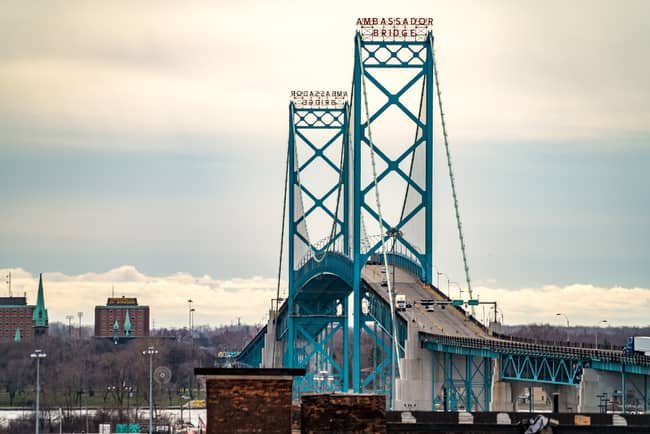
Ambassador Bridge Key Facts
| Detail | Information |
| Official name | Ambassador International Bridge |
| Location | Detroit River, between Detroit, Michigan (USA) and Windsor, Ontario (Canada) |
| Coordinates | Approx. 42.3120° N, 83.0741° W |
| Owners/operators | Detroit International Bridge Company (US) and Canadian Transit Company (Canada), privately owned |
| Bridge type | Suspension bridge with steel truss approaches |
| Designer/builder | McClintic-Marshall Company |
| Construction began | 1927 |
| Opened | November 1929 |
| Original cost | About $23.5 million |
| Total length | About 7,500 ft (2,286 m) |
| Main span | 1,850 ft (564 m) |
| Tower height | About 386 ft (118 m) above the water |
| Clearance | About 152 ft (46 m) above the river |
| Lanes | 4 |
| Road connections | I-75 and I-96 in Detroit; Huron Church Road toward Highway 401 in Windsor |
| Car/bus/motorcycle toll (2026) | $10.00 USD / $14.00 CAD |
| Vehicle with trailer toll (2026) | $20.00 USD / $28.00 CAD |
| Commercial vehicles (2026) | $15 USD per axle with A-Pass or E-ZPass; $20 USD per axle without an account |
| Payment | Cash, credit card, Premier pass, E-ZPass |
| Pedestrians and cyclists | Not permitted |
| Travel documents | Passport, passport card, NEXUS card, Enhanced Driver’s License or other accepted document |
| Time zone | Eastern Time: UTC−5 (EST), UTC−4 (EDT, second Sunday in March to first Sunday in November) |
Between Detroit and Windsor
On the Detroit side, the bridge lands in Southwest Detroit, near the Mexicantown neighborhood, with direct connections to I-75 and I-96. Its tall towers are visible from much of the city’s riverfront. On the Canadian side, it comes down in Windsor’s west end, near the University of Windsor. Huron Church Road carries traffic from the bridge toward Highway 401, the main highway to London, Toronto and the rest of southern Ontario.
The Detroit River is a busy shipping lane that connects Lake Huron and Lake St. Clair with Lake Erie. Great Lakes freighters pass under the bridge day and night, carrying iron ore, grain, coal and other cargo, which is why the deck was set so high above the water.
A Record-Setting Span
The Ambassador Bridge is a classic suspension bridge, with two tall steel towers and a pair of main cables that support the central deck.
- The main span between the towers is 1,850 feet. When the bridge opened in 1929, that was the longest suspension span in the world. It held the record until the George Washington Bridge opened in New York in 1931.
- Including its steel truss approaches, the bridge stretches about 7,500 feet, roughly 1.4 miles.
- The towers rise about 386 feet above the river.
- The deck gives ships about 152 feet of clearance.
The bridge was built by the McClintic-Marshall Company of Pittsburgh, one of the major steel builders of its day. It went up quickly, and the whole project took only about two and a half years.
What You’ll Pay in 2026
Toll rates went up on January 1, 2026.
| Vehicle | Toll |
| Car, bus or motorcycle | $10.00 USD / $14.00 CAD |
| Car, bus or motorcycle with trailer | $20.00 USD / $28.00 CAD |
| Commercial vehicle, with A-Pass or E-ZPass | $15.00 USD per axle |
| Commercial vehicle, without an account | $20.00 USD per axle |
Tips for drivers:
- The passenger rate is the same whether you pay with cash, a credit card, a Premier pass or E-ZPass.
- If you’re towing a trailer, the toll doubles.
- Oversize loads may need an escort, which is priced separately.
- The Detroit–Windsor Tunnel and the new Gordie Howe International Bridge are two other nearby crossings with their own tolls. Compare routes and wait times before you head to the border.
Crossing the Border
The Ambassador Bridge is an international crossing with customs and immigration inspection at both ends:
- Everyone in the vehicle needs an accepted travel document, such as a passport, passport card, NEXUS card or Enhanced Driver’s License. Check current entry rules for your citizenship before you travel.
- The bridge has no sidewalk, and pedestrians and cyclists aren’t allowed. Travelers without a car can use transit options such as the Transit Windsor Tunnel Bus, which runs through the Detroit–Windsor Tunnel.
- NEXUS members can use dedicated lanes, which often move faster during busy periods.
- Duty-free shops operate near the bridge plazas.
- Wait times vary with the time of day and season. Checking current border wait times before you set out can save a long delay.
How the Bridge Was Built
For more than a century, people crossing between Detroit and Windsor relied on ferries. Plans for a bridge over the Detroit River had been discussed since the 1870s. Railroad tunnels were built in the early 1900s, but there was still no road crossing, and the ferries couldn’t keep up with the growing car traffic of the 1920s.
A group of Detroit investors, working with New York businessman Joseph A. Bower, formed the Detroit International Bridge Company to build and run a bridge with private money. Construction began in 1927. Crews built the towers on land along each riverbank rather than in the water, which helped them move quickly. The cables were spun across the river, and the deck was hung in place.
The bridge opened in November 1929, just weeks after the stock market crash, and the name “Ambassador” was chosen to show its role as a friendly link between two nations. The following year, the Detroit–Windsor Tunnel opened nearby, giving the two cities a second road crossing.
A Lifeline for Trade
The Ambassador Bridge is best known for the goods it carries. Southeast Michigan and southern Ontario form one of the world’s largest auto manufacturing regions, and parts often cross the border several times before a car is finished. For decades, the bridge carried more than a quarter of all merchandise trade between the two countries by value, making it one of the most important trade crossings in North America.
Trucks make up a large share of its traffic, and the plazas on both sides are built to handle heavy commercial loads. In July 2026, the Gordie Howe International Bridge opened a few miles downriver, giving truck and car traffic another crossing between Detroit and Windsor.
Seeing the Bridge
- On the Detroit side, the riverfront parks near Southwest Detroit and Mexicantown have views of the towers and the river.
- On the Windsor side, the riverfront trail and parks along the Detroit River have some of the best views of the bridge, especially at sunset with the Detroit skyline behind it.
- The bridge is lit at night, and its lights reflect on the river.
- Freighters passing under the main span make for good photos from either shore.
A Few More Facts
- The Ambassador Bridge is one of the few major international crossings in the world owned by a private company, not a government agency.
- Because Windsor lies south of Detroit, travelers leaving the US on the bridge actually head south into Canada.
- The bridge was designed to carry far more traffic than it had in 1929, which has helped it keep up with the huge growth in trade over the decades.
- The Detroit River below it is part of an international shipping route that runs from the Atlantic Ocean, through the St. Lawrence Seaway and the Great Lakes, to ports deep in the heart of North America.
FAQs
Q1. How much is the Ambassador Bridge toll in 2026?
A. A car, bus, or motorcycle pays $10.00 USD or $14.00 CAD, while vehicles with trailers pay $20.00 USD or $28.00 CAD.
Q2. Does the Ambassador Bridge accept E-ZPass?
A. Yes. The Ambassador Bridge accepts E-ZPass, along with cash, credit cards, and Premier passes.
Q3. How long is the Ambassador Bridge?
A. The Ambassador Bridge has a total length of approximately 7,500 feet, while its main suspension span measures about 1,850 feet.
Q4. How tall is the Ambassador Bridge?
A. The bridge’s towers rise approximately 386 feet above the Detroit River, while the bridge deck provides about 152 feet of clearance above the water.
Q5. When was the Ambassador Bridge built?
A. Construction of the Ambassador Bridge began in 1927, and the bridge officially opened in November 1929.
Q6. Who owns the Ambassador Bridge?
A. The Ambassador Bridge is privately owned through the Detroit International Bridge Company in the United States and the Canadian Transit Company in Canada.
Q7. Can you walk across the Ambassador Bridge?
A. No. Pedestrians and cyclists are not permitted to cross the Ambassador Bridge.
Q8. Why do you go south to Canada from Detroit?
A. The shape and course of the Detroit River place Windsor, Ontario, south of downtown Detroit, making it possible to travel south from the United States into Canada at this crossing.
Q9. What documents do I need to cross the Ambassador Bridge?
A. Travellers need an accepted border-crossing document, which may include a passport, passport card, NEXUS card, Enhanced Driver’s License, or another document accepted for their particular citizenship and travel circumstances.
Q10. Was the Ambassador Bridge ever the longest suspension bridge?
A. Yes. Its 1,850-foot main span was the world’s longest suspension-bridge span when the Ambassador Bridge opened in 1929. It held the record until the George Washington Bridge opened in 1931.



Post Comment