Colorado Street Bridge, Pasadena, CA: Location, Length, Height, Toll, History & Facts
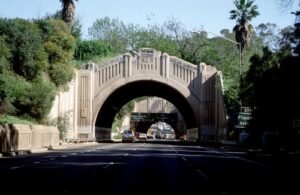
Colorado Street Bridge looks like it was borrowed from ancient Rome. Its row of tall concrete arches sweeps across the Arroyo Seco canyon in a graceful curve, topped with ornate Beaux-Arts railings and old-fashioned lamp posts. When it opened on December 13, 1913, Pasadena celebrated with a parade of specially decorated automobiles, and the bridge was hailed as the highest concrete bridge in the world. It later carried historic Route 66 over the arroyo and has appeared in many films, including La La Land. A National Historic Civil Engineering Landmark and listed on the National Register of Historic Places, it’s free for drivers, walkers and cyclists.
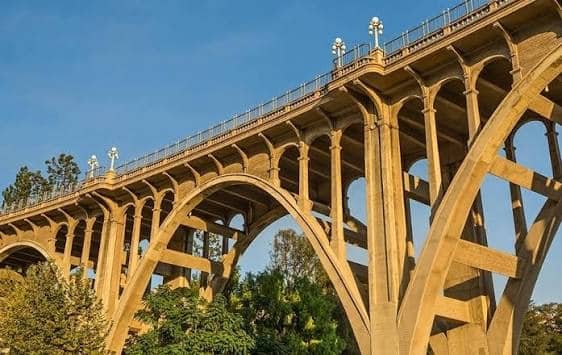
Colorado Street Bridge Key Facts
| Detail | Information |
| Location | Arroyo Seco, carrying Colorado Boulevard on the west side of Pasadena, Los Angeles County, California |
| Coordinates | Approx. 34.1453° N, 118.1650° W |
| Road | Colorado Boulevard (originally Colorado Street) |
| Owner | City of Pasadena |
| Bridge type | Reinforced concrete open-spandrel arch bridge |
| Designer | Waddell & Harrington (John Alexander Low Waddell), Kansas City |
| Builder | John Drake Mercereau |
| Opened | December 13, 1913 |
| Original cost | About $240,000 |
| Total length | About 1,467.5 ft (often cited as 1,486 ft) |
| Width | About 38 ft |
| Maximum height | About 148.5–150 ft above the streambed |
| Arches | 11, including a main span of about 223–233 ft |
| Style | Beaux-Arts arches, light standards and railings |
| Route 66 | Carried Route 66 from the 1930s until 1940 |
| Seismic retrofit | Closed in 1989; about $27 million retrofit; reopened December 1993 |
| Recognition | National Register of Historic Places; ASCE National Historic Civil Engineering Landmark |
| Community celebration | Colorado Street Bridge Party, hosted by Pasadena Heritage |
| Toll | None |
| Time zone | Pacific Time: UTC−8 (PST), UTC−7 (PDT, second Sunday in March to first Sunday in November) |
Across the Arroyo Seco
The Colorado Street Bridge carries Colorado Boulevard across the Arroyo Seco, a wide, deep canyon on the west side of Pasadena. The arroyo runs from the San Gabriel Mountains down toward the Los Angeles River, and its wooded floor is home to parks, trails and the famous Rose Bowl stadium a short distance upstream.
On the east side, the bridge leads into Old Pasadena, the city’s historic downtown. On the west side, it continues toward Eagle Rock and Los Angeles. The bridge’s graceful curve and towering arches make it one of the most recognizable landmarks in Southern California.
Arches, Curves and Lamps
The Colorado Street Bridge is a reinforced concrete open-spandrel arch bridge, with the roadway resting on columns above a series of arches.
- The bridge is about 1,467.5 feet long. Some sources give 1,486 feet, depending on how the approaches are measured.
- It’s about 38 feet wide.
- At its highest point, it rises about 150 feet above the arroyo floor.
- It has 11 arches, including a main span of more than 220 feet.
- Its Beaux-Arts design includes decorative lamp posts, railings and arches that echo classical architecture.
One of the bridge’s most distinctive features is its gentle curve. Engineers originally planned a straight bridge, but the builder adjusted the route to follow firmer ground for the foundations. The result is a sweeping curve that adds to its beauty.
Free to Cross
There’s no toll on the Colorado Street Bridge. Tips for visiting:
- Drivers can cross on Colorado Boulevard between Old Pasadena and the west side.
- Pedestrians and cyclists can use the sidewalks, which have wonderful views of the arroyo, the San Gabriel Mountains and the nearby historic Vista del Arroyo building.
- For the best photos, head down into the arroyo below the bridge. Lower Arroyo Seco Park and Desiderio Park offer dramatic views looking up at the arches.
- At sunset and at night, the lamps on the bridge glow beautifully against the evening sky.
A Street-Level Crossing for Pasadena
In the early 1900s, the only way across the Arroyo Seco near Colorado Street was the Scoville Bridge, a small, low bridge near the bottom of the canyon. Wagons and early cars had to climb down into the arroyo and back up again.
As Pasadena grew, the city decided to build a new bridge that would cross the canyon at street level. It hired the Kansas City engineering firm of Waddell & Harrington, led by John Alexander Low Waddell, one of the most famous bridge engineers in the country. Builder John Drake Mercereau oversaw construction and made adjustments to the design to place the foundations on solid ground.
The bridge was completed in 1913 at a cost of about $240,000. On December 13, 1913, Pasadena residents decorated their cars and paraded across the new span to celebrate. At the time, it was described as the highest concrete bridge in the world.
On Historic Route 66
The Colorado Street Bridge became part of the fabled Route 66, the “Mother Road” that ran from Chicago to Santa Monica. Travelers heading for the Pacific crossed the bridge on their way through Pasadena until 1940, when the new Arroyo Seco Parkway, one of the first freeways in the West, opened nearby.
The busy traffic also helped transform Colorado Street into Pasadena’s main commercial corridor. In 1958, it was renamed Colorado Boulevard. It’s famous today as the route of the annual Tournament of Roses Parade.
Restored for a New Century
By the 1980s, the bridge needed major repairs, and it was closed in 1989 so it could be strengthened against earthquakes. Pasadena Heritage, a local preservation group, led a campaign to save the bridge, writing letters, lobbying for funding and hosting the first Colorado Street Bridge Party to build public support.
Federal, state and local funding came together for a $27 million renovation that included seismic upgrades and a historically accurate restoration of the arches, railings and lamps. The bridge reopened in December 1993, looking much as it did in 1913.
The Colorado Street Bridge Party has since become a beloved Pasadena tradition, with music, dancing, food and family activities right on the bridge deck.
Landmark Status
The Colorado Street Bridge has been recognized for both its engineering and its beauty:
- It’s listed on the National Register of Historic Places.
- The American Society of Civil Engineers has named it a National Historic Civil Engineering Landmark.
- It’s a designated cultural heritage landmark of the City of Pasadena.
Things to Do Nearby
- Old Pasadena, just east of the bridge, is full of historic buildings, shops and restaurants.
- The Rose Bowl, in the Arroyo Seco upstream, hosts college football and a famous monthly flea market.
- The Norton Simon Museum, on Colorado Boulevard, has a world-class art collection.
- Lower Arroyo Seco Park offers trails beneath the bridge and great photo spots.
- The Vista del Arroyo building, a former grand hotel next to the bridge, now houses a federal courthouse with Spanish Colonial Revival architecture.
FAQs
Q1. Is there a toll on the Colorado Street Bridge?
No. The Colorado Street Bridge is free to cross.
Q2. How long is the Colorado Street Bridge?
It’s about 1,467.5 feet long, often cited as 1,486 feet.
Q3. How high is the Colorado Street Bridge?
It rises about 150 feet above the Arroyo Seco streambed at its highest point.
Q4. When was the Colorado Street Bridge built?
It opened on December 13, 1913.
Q5. Who designed the Colorado Street Bridge?
It was designed by the Kansas City firm Waddell & Harrington, led by engineer J.A.L. Waddell.
Q6. Was the Colorado Street Bridge part of Route 66?
Yes. It carried Route 66 over the Arroyo Seco until 1940.
Q7. Why does the Colorado Street Bridge curve?
The builder adjusted its path to place the foundations on solid ground, giving it a graceful curve.
Q8. Can you walk across the Colorado Street Bridge?
Yes. Sidewalks on both sides are open to pedestrians.
Q9. Has the Colorado Street Bridge appeared in movies?
Yes. It has appeared in many films and TV shows, including La La Land.
Q10. When was the Colorado Street Bridge renovated?
It was closed in 1989 for a $27 million seismic retrofit and restoration, and reopened in December 1993.



Post Comment