George Washington Bridge, New York, NY: Location, Length, Height, Toll, History & Facts
The George Washington Bridge towers were never supposed to show their bare steel. Architect Cass Gilbert planned to cover them in concrete and granite. When the bridge opened in October 1931, in the middle of the Great Depression, the cladding had been dropped, and people found they liked the exposed crisscrossing ironwork just as it was. More than 90 years later, those 604-foot steel towers still stand over the Hudson River between Fort Lee, New Jersey and Washington Heights in Manhattan. The bridge now carries around 278,000 vehicles on an average day, more than any other motor vehicle bridge in the world.
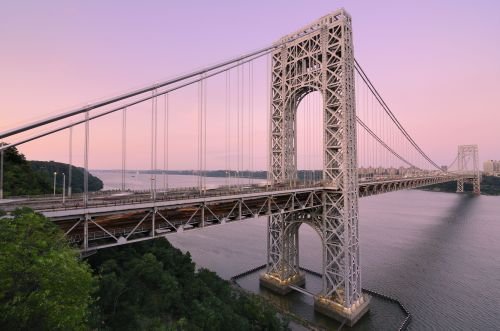
George Washington Bridge Facts
| Detail | Information |
| Location | Hudson River, between Washington Heights (Manhattan, New York) and Fort Lee (New Jersey) |
| Coordinates | Approx. 40.8517° N, 73.9527° W |
| Highways | I-95, US 1/9, US 46 (New Jersey side) |
| Bridge type | Double-decked suspension bridge |
| Chief engineer | Othmar H. Ammann |
| Architect | Cass Gilbert |
| Construction began | October 1927 |
| Opened | October 25, 1931 (dedicated October 24) |
| Lower deck opened | August 1962 |
| Owner/operator | Port Authority of New York and New Jersey |
| Total length | 4,760 ft (1,450 m) |
| Main span | 3,500 ft (1,067 m) |
| Width | 119 ft (36 m) |
| Tower height | 604 ft (184 m) |
| Clearance at midspan | 212 ft (65 m) |
| Main cables | 4, each about 36 in (91 cm) in diameter |
| Vehicle lanes | 14 (8 on the upper level, 6 on the lower level) |
| Average daily traffic | About 278,000 vehicles (2025) |
| Toll direction | Eastbound only (into New York) |
| Car toll: E-ZPass peak | $16.79 |
| Car toll: E-ZPass off-peak | $14.79 |
| Car toll: E-ZPass Mid-Tier | $19.55 (applies when the tag isn’t read properly) |
| Car toll: Tolls by Mail | $23.30 |
| Peak hours | Weekdays 6–10 am and 4–8 pm; weekends 11 am–9 pm |
| Cash tolls | Not accepted |
| Walking and cycling | Free; north sidewalk currently shared, with the south sidewalk being rebuilt |
| Nicknames | GWB, “The George” |
| Time zone | Eastern Time: UTC−5 (EST), UTC−4 (EDT, second Sunday in March to first Sunday in November) |
Between the Palisades and Washington Heights
On the New Jersey side, the bridge begins at the top of the Palisades, the tall rock cliffs along the western bank of the Hudson. That high ground is why the deck could clear the river by more than 200 feet without long, gradual approach ramps. The towers stand close to each shore, and the roadway leads almost straight into Fort Lee on one end and upper Manhattan on the other.
The Manhattan end lands in Washington Heights, around West 178th to 181st Streets. Fort Washington Park runs along the riverbank below. Directly under the Manhattan tower sits the Little Red Lighthouse, which is dwarfed by the bridge above it. It was saved from demolition partly thanks to a 1942 children’s book, The Little Red Lighthouse and the Great Gray Bridge, and it’s now one of the best spots to photograph the span from below.
A Span That Nearly Doubled the World Record
The GWB’s main span measures 3,500 feet. When it opened in 1931, that was almost twice as long as the previous record holder, Detroit’s Ambassador Bridge. It stayed the longest suspension span in the world until the Golden Gate Bridge opened in 1937.
The rest of the bridge is built on the same huge scale:
- The total length between the anchorages is 4,760 feet, about 0.9 miles.
- The steel towers rise 604 feet, and the deck sits 212 feet above the river at midspan.
- Four main cables, each about three feet thick, hold up both decks. The wire inside them, laid end to end, would wrap around the Earth about four times.
- The bridge is 119 feet wide and has 14 lanes of traffic across two levels.
Othmar Ammann designed the cables and towers to carry a future second deck from the very beginning. That foresight paid off 31 years later.
What You’ll Pay to Cross
The toll is collected in one direction only, from drivers heading east into New York. Crossing into New Jersey is free. Like all Port Authority crossings, the GWB is fully cashless. Current passenger car rates, in effect since January 4, 2026, are:
| Payment method | Car toll |
| E-ZPass peak | $16.79 |
| E-ZPass off-peak | $14.79 |
| E-ZPass Mid-Tier | $19.55 |
| Tolls by Mail | $23.30 |
Some practical points for drivers:
- Peak hours are 6 to 10 am and 4 to 8 pm on weekdays, and 11 am to 9 pm on weekends. All other times are off-peak.
- The Mid-Tier rate applies when an E-ZPass tag isn’t mounted correctly and the reader can’t pick it up. Stick the tag firmly behind the rearview mirror.
- A driver without E-ZPass pays $8.51 more per crossing than an off-peak E-ZPass user. For someone crossing five days a week, that difference adds up to more than $2,000 a year.
- The Port Authority has approved phasing out the off-peak discount between 2027 and 2030, when off-peak will match the peak rate.
- The bridge reaches Manhattan well north of 60th Street, so the Congestion Relief Zone charge doesn’t apply unless you drive south into Midtown or Downtown.
From Idea to Opening Day
For most of the 19th and early 20th centuries, anyone crossing the Hudson between New Jersey and Manhattan had to take a ferry. Ideas for a bridge had been floating around since the early 1800s. The project finally got going after the Port of New York Authority was created in 1921 to manage crossings between the two states.
Othmar Ammann, a Swiss-born engineer, pushed for a suspension bridge between Fort Lee and 178th Street, where the cliffs on the New Jersey side gave a natural head start. Construction began in October 1927. Crews sank the New Jersey tower’s foundations right at the base of the Palisades, while the Manhattan tower rose next to the lighthouse on Jeffrey’s Hook.
The bridge was finished about eight months ahead of schedule. It was dedicated on October 24, 1931, and opened to traffic the next day. At first it was called the Hudson River Bridge, but the public wanted it named for George Washington. Revolutionary War forts had stood on both ends of the site, so the name was a natural fit.
The Second Deck, Right on Cue
Traffic grew so fast after World War II that the Port Authority used the space Ammann had left for a second deck. The lower level, with six new lanes, opened in August 1962, increasing the bridge’s capacity by 75 percent. Ammann, then in his early 80s, lived to see his original plan completed.
That double-deck layout is why the GWB carries so many vehicles today. Many drivers heading between New England and the rest of the East Coast pass through here, since I-95 runs straight across the bridge.
Restoring the George
The Port Authority is in the middle of a roughly $2 billion program called Restoring the George. Its centerpiece is the replacement of all the original suspender ropes, the vertical cables that hang from the main cables and support the deck. It’s the first time they’ve been replaced since 1931. Crews are also cleaning and dehumidifying the main cables to protect them for decades to come.
The walkways are getting a major upgrade as part of the same work. The rebuilt north sidewalk opened in February 2023, replacing 171 steps at its entrances with gently sloped ramps. That makes the bridge accessible to wheelchairs, strollers and cyclists who no longer have to carry their bikes up stairs. Two new viewing platforms, called belvederes, were added, one on each end. The south sidewalk is being rebuilt in the same way. Once it opens, pedestrians will use the south side and cyclists the north.
Crossing on Foot or by Bike
- The walk from one end to the other takes about 20 to 30 minutes.
- In Manhattan, the north path starts at West 180th Street and Cabrini Boulevard. In New Jersey, it starts on Hudson Terrace in Fort Lee.
- The belvedere on the New York end has views up the Hudson toward the Palisades. The one on the New Jersey end looks straight at the tower.
- Cyclists heading north can continue onto Palisades Interstate Park, a popular weekend ride along the cliffs toward Nyack.
- The path sometimes closes overnight or during construction, so check the Port Authority’s GWB page before planning a late-night crossing.
Details Worth Knowing
- On major holidays, the world’s largest free-flying American flag, about 60 by 90 feet, hangs from the New Jersey tower.
- The towers are lit up for special occasions and events, including Independence Day.
- The bridge is roughly halfway between the Statue of Liberty and the Tappan Zee (Mario Cuomo) Bridge, making it one of the landmarks that anchor the lower Hudson Valley.
- Le Corbusier, the Swiss-French architect, called it the most beautiful bridge in the world when he visited New York in the 1930s.
- It was designated a National Historic Civil Engineering Landmark in 1981.
FAQs
Q1. How much is the George Washington Bridge toll in 2026?
A car pays $16.79 with E-ZPass at peak times, $14.79 off-peak, and $23.30 by Tolls by Mail.
Q2. Do you pay the George Washington Bridge toll both ways?
No. The toll is charged only when driving east into New York, and crossing into New Jersey is free.
Q3. How long is the George Washington Bridge?
It’s 4,760 feet long, and its main span between the towers is 3,500 feet.
Q4. How tall is the George Washington Bridge?
The steel towers rise 604 feet, and the deck clears the Hudson by 212 feet at midspan.
Q5. When was the George Washington Bridge built?
Construction began in October 1927, and the bridge opened on October 25, 1931. The lower deck was added in 1962.
Q6. Who designed the George Washington Bridge?
Othmar H. Ammann was the chief engineer, and Cass Gilbert was the architect.
Q7. Is the George Washington Bridge the busiest bridge in the world?
Yes. With about 278,000 vehicles a day, it’s considered the world’s busiest motor vehicle bridge.
Q8. Can you walk across the George Washington Bridge?
Yes. The north sidewalk is open to pedestrians and cyclists, and walking or biking across is free.
Q9. How many lanes does the George Washington Bridge have?
It has 14 lanes: eight on the upper level and six on the lower level.
Q10. What is the little lighthouse under the George Washington Bridge?
It’s the Little Red Lighthouse at Jeffrey’s Hook, which became famous through a 1942 children’s book.



Post Comment