Williamsburg Bridge, New York, NY: Location, Length, Height, Toll, History & Facts
The Williamsburg Bridge walkway is where jazz saxophonist Sonny Rollins went to practice between 1959 and 1961. He’d climb up above the East River at night so he could play for hours without bothering his neighbors, and the album he released after that break, The Bridge, is named for this span. The Williamsburg Bridge links Delancey Street on Manhattan’s Lower East Side with Williamsburg in Brooklyn. When it opened in December 1903, its 1,600-foot main span was the longest of any suspension bridge in the world. Today it carries eight lanes of traffic, the J, M and Z subway lines, and more daily cyclists than the Brooklyn Bridge, and there’s no toll.
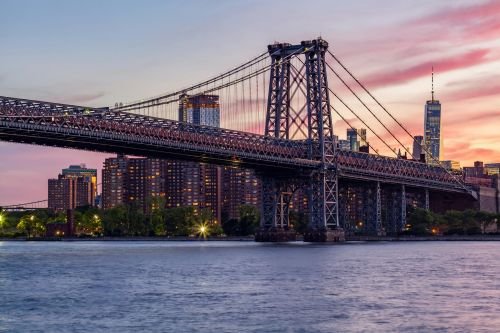
Williamsburg Bridge at a Glance
| Detail | Information |
| Location | East River, between the Lower East Side (Manhattan) and Williamsburg (Brooklyn), New York City, NY, USA |
| Coordinates | Approx. 40.7136° N, 73.9720° W |
| Manhattan end | Delancey Street at Clinton Street |
| Brooklyn end | Broadway area, near Havemeyer Street and the BQE (I-278) |
| Bridge type | Suspension bridge with truss-supported side spans |
| Chief engineer | Leffert L. Buck |
| Architect | Henry Hornbostel |
| Construction began | 1896 |
| Opened | December 19, 1903 (trains from 1908) |
| Original name | East River Bridge |
| Operator | New York City Department of Transportation (NYC DOT) |
| Total length | 7,308 ft (2,227 m) |
| Main span | 1,600 ft (488 m) |
| Side spans (each) | 596.5 ft (182 m), not suspended |
| Deck width | 118 ft (36 m) |
| Clearance at center | 135 ft (41 m) |
| Tower height | Roughly 310–335 ft (94–102 m), depending on where it’s measured |
| Tower material | Steel |
| Main cables | 4, each 18¾ in (48 cm) in diameter, with more than 10,000 wires |
| Vehicle lanes | 8 |
| Subway | J, M and Z trains (2 tracks) |
| Walkway and bikeway | Separate paths on the south and north sides, meeting at the Manhattan entrance |
| Average daily traffic (2024) | 87,987 vehicles; 8,645 cyclists; 4,440 pedestrians |
| Nearest subway (Manhattan) | Delancey St–Essex St (F, J, M, Z) |
| Nearest subway (Brooklyn) | Marcy Ave (J, M, Z) |
| Toll | None |
| Time zone | Eastern Time: UTC−5 (EST), UTC−4 (EDT, second Sunday in March to first Sunday in November) |
From Delancey Street to Broadway
Delancey Street in Manhattan was widened specifically to carry traffic onto the bridge. It runs straight up the approach ramp, lined with bakeries, bars and old tenement buildings. The walkway and bike path share one entrance at Clinton and Delancey, so pay attention in the first hundred yards while cyclists and walkers sort themselves out.
In Brooklyn, the roadway lands near Broadway, a few blocks from the Brooklyn-Queens Expressway. Cyclists enter at Washington Plaza, around Roebling and South 4th Streets, and pedestrians have their own entrance a short walk away. Getting to the bridge by subway is easy: Delancey St–Essex St is on the Manhattan side, and Marcy Avenue is right next to the Brooklyn approach.
How It Measures Up
The total length, including both approaches, is 7,308 feet, just under 1.4 miles, which makes it the longest of the four East River bridges between Manhattan and Brooklyn. The main span measures 1,600 feet. That’s only 4.5 feet longer than the Brooklyn Bridge, but it was enough to take the world record in 1903. The Williamsburg Bridge held that title for 21 years, until the Bear Mountain Bridge opened on the Hudson River in 1924.
The deck is 118 feet wide, the widest of any East River bridge, and sits 135 feet above the water at midspan. Engineer Leffert Buck got permission to build a bit lower than the 140 feet the federal government had first required, which kept the approach ramps from climbing too steeply.
A detail that surprises many people: only the center span actually hangs from the cables. The two 596.5-foot side spans rest on steel trusses underneath, so the main cables run down to the anchorages without carrying those sections of road.
Steel Instead of Stone
Earlier suspension bridges, including the Brooklyn Bridge, stood on heavy granite towers. The Williamsburg Bridge was the first long-span suspension bridge built with all-steel towers. That choice made it faster to build and let the structure carry heavy rail loads, and every major suspension bridge since has followed the same approach.
The rest of the bridge is similarly practical:
- The four main cables are each 18¾ inches thick, heavier than the Brooklyn Bridge’s cables, because this bridge was designed from the start to carry trains.
- Deep stiffening trusses, about 40 feet high, keep the deck rigid under traffic.
- The latticed steel towers give the bridge its gridded, industrial look, very different from the Gothic stone arches downstream.
Architect Henry Hornbostel was brought in during construction to refine the design and add finishing touches, including the ornamented tower tops.
Crossing Costs Nothing
There’s no toll on the Williamsburg Bridge for drivers, cyclists or pedestrians. Like the Brooklyn, Manhattan and Queensboro bridges, it is owned and run by the city, and none of these crossings charge. Drivers heading between the Lower East Side and North Brooklyn often find it the quickest option, particularly because it connects directly to the BQE on the Brooklyn side.
Building It, 1896 to 1903
By the 1890s, Brooklyn was growing fast, and the Brooklyn Bridge alone couldn’t handle all the people crossing the river. A second bridge was approved to connect the Lower East Side with the Eastern District of Brooklyn, which later became known as Williamsburg. Leffert Buck, a veteran engineer who had built major bridges in Peru and across the Niagara River, was named chief engineer in 1895, and work began the following year.
The bridge opened on the afternoon of December 19, 1903. The first people across were in horse-drawn carriages, on bicycles and on foot. The bridge was among the last major spans designed with horse traffic in mind, but it was built with room for rail as well. Trolleys and elevated trains started running across it in 1908, and those tracks became part of today’s J, M and Z lines. Streetcars kept crossing until 1948.
The bridge changed the neighborhoods at both ends almost immediately. Many families from the crowded Lower East Side moved across the river to Williamsburg, which grew quickly in the years that followed.
Rebuilt for a Second Century
After more than 80 years of heavy use, the city launched one of the biggest bridge rehabilitation programs in its history. From the 1990s into the early 2000s, NYC DOT rebuilt the bridge section by section while keeping it open. The work included new roadway decks, restored cables, a new south footpath, and a rebuilt Manhattan approach with a new north bikeway. More recent work has focused on seismic strengthening of the side spans.
That rehabilitation is the main reason the Williamsburg Bridge is now such a popular bike route. In 2024, NYC DOT counted more than 8,600 cyclists a day on it, well above the Brooklyn Bridge’s total.
On Foot or on Two Wheels
The crossing takes about 30 to 40 minutes to walk and roughly 10 minutes by bike. It’s steeper than the Brooklyn or Manhattan bridges, so expect a real climb from either end.
- Pedestrians and cyclists have separate paths across most of the bridge. They merge only near the Manhattan entrance.
- The path is mostly steel and concrete, not wooden boards, so it stays usable in wet weather.
- The views look south toward the Manhattan Bridge, the Empire State Building and the Midtown skyline. Sunsets over Manhattan are especially good from the Brooklyn half.
- Murals and colorful tags line much of the walkway. Many visitors find this part of the bridge’s character.
- The bridge gets far fewer tourists than the Brooklyn Bridge, so you can actually stop for a photo without holding anyone up.
- J, M and Z trains rumble along right beside the path, which makes for good action shots.
A Few More Facts
- The bridge’s original official name was the East River Bridge. People started calling it the Williamsburg Bridge after the neighborhood it served, and that name stuck.
- Sonny Rollins’s practice sessions became so well known that musicians and fans have campaigned to rename the bridge in his honor.
- Its steel towers inspired later suspension bridges across the United States, including many built during the long-span boom of the 1920s and 1930s.
- The Brooklyn approach passes over Domino Park, the former sugar refinery waterfront, which now has a playground and good views of the bridge from below.
FAQs
Q1. Is there a toll on the Williamsburg Bridge?
No. The Williamsburg Bridge is free for cars, cyclists and pedestrians in both directions.
Q2. How long is the Williamsburg Bridge?
It’s 7,308 feet long in total, including the approaches. The main span is 1,600 feet.
Q3. How high is the Williamsburg Bridge?
The deck sits 135 feet above the East River at midspan. The steel towers rise roughly 310 to 335 feet, depending on where they’re measured from.
Q4. When did the Williamsburg Bridge open?
It opened on December 19, 1903, and trains started crossing it in 1908.
Q5. Who designed the Williamsburg Bridge?
Leffert L. Buck was the chief engineer, and architect Henry Hornbostel refined the design during construction.
Q6. Which subway lines cross the Williamsburg Bridge?
The J, M and Z trains cross it.
Q7. Can you walk across the Williamsburg Bridge?
Yes. The walkway starts at Clinton and Delancey Streets in Manhattan and comes down in Williamsburg, Brooklyn.
Q8. How long does it take to walk the Williamsburg Bridge?
Most people take 30 to 40 minutes to walk it one way.
Q9. Was the Williamsburg Bridge ever the longest suspension bridge in the world?
Yes. Its 1,600-foot main span held the record from 1903 until 1924.
Q10. Why is the Williamsburg Bridge linked to Sonny Rollins?
The jazz saxophonist practiced on its walkway from 1959 to 1961, and he named his 1962 album The Bridge after it.


Post Comment