Congress Avenue Bridge, Austin, TX: Location, Length, Height, Toll, History & Facts
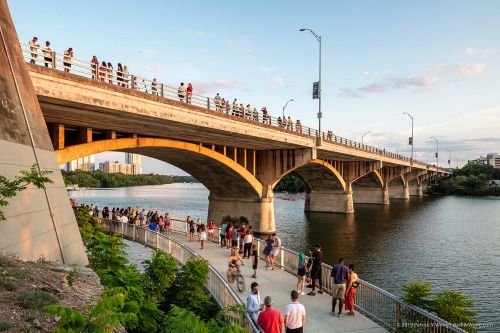
Congress Avenue Bridge has one of the most unusual evening shows in America. From spring through fall, as the sun sets over Austin, up to 1.5 million Mexican free-tailed bats pour out from under the bridge in a long, swirling ribbon and stream across Lady Bird Lake to feed. It’s the largest urban bat colony in North America. The concrete arch bridge opened on April 4, 1910, and carries Congress Avenue from downtown Austin, with the Texas State Capitol at its north end, to the lively South Congress district. In 2006 it was renamed the Ann W. Richards Congress Avenue Bridge in honor of the late Texas governor. It’s free to cross, and the bats charge no admission.
Congress Avenue Bridge Key Facts
| Detail | Information |
| Official name | Ann W. Richards Congress Avenue Bridge (since November 16, 2006) |
| Other names | Congress Avenue Bridge; South Congress Avenue Bridge; “Bat Bridge” |
| Location | Lady Bird Lake (Colorado River), between downtown Austin and South Congress (SoCo), Austin, Texas |
| Coordinates | Approx. 30.2617° N, 97.7451° W |
| Road | Congress Avenue |
| Owner | City of Austin |
| Bridge type | Concrete arch bridge |
| Opened | April 4, 1910 |
| Original cost | About $209,000 |
| Rehabilitated | 1980 (the work that created the bats’ roosting crevices) |
| Total length | About 946 ft (288 m) |
| Main spans | About 120 ft each |
| Deck height | Roughly 45 ft above the lake |
| Lanes | Traffic lanes in both directions, with sidewalks on both sides |
| Bat colony | 750,000 to 1.5 million Mexican free-tailed bats |
| Bat season | Roughly March to early November, peaking in August |
| Bat watchers | Up to about 100,000 visitors a year |
| Named for | Ann W. Richards, 45th Governor of Texas |
| Toll | None |
| Time zone | Central Time: UTC−6 (CST), UTC−5 (CDT, second Sunday in March to first Sunday in November) |
From the Capitol to SoCo
The Congress Avenue Bridge sits right in the heart of Austin. Congress Avenue is the city’s main street, and from the bridge you can look straight north up the avenue to the pink granite dome of the Texas State Capitol. The bridge’s north end lands in downtown Austin, near the entertainment district and office towers. Its south end leads onto South Congress Avenue, known as “SoCo,” famous for its quirky shops, food trucks, music venues and views back toward the Capitol.
The bridge crosses Lady Bird Lake, a reservoir on the Colorado River in the middle of Austin. The lake was formed after Longhorn Dam was completed in 1960, so before then the bridge crossed the open Colorado River. Today the Ann and Roy Butler Hike-and-Bike Trail circles the lake beneath the bridge.
Length, Height and Design
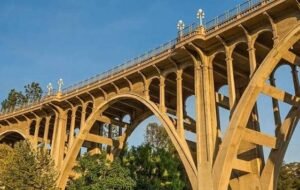
The Congress Avenue Bridge is a classic concrete arch bridge from the early 1900s.
- The total length is about 946 feet.
- Its main spans are about 120 feet each, carried on graceful concrete arches.
- The deck sits roughly 45 feet above the lake.
- The bridge carries traffic lanes in both directions, with sidewalks on both sides.
The concrete arches are attractive, but what makes the bridge famous is hidden underneath. During the 1980 rehabilitation, engineers built a new deck structure with deep, narrow crevices on its underside. The gaps turned out to be perfect roosting spots for bats.
Free to Cross
There’s no toll on the Congress Avenue Bridge. Tips for visiting:
- Drivers use the bridge as the main route between downtown and South Congress. Expect heavy traffic around rush hour and during big events.
- Pedestrians can walk across on the sidewalks for great views of the Capitol, the downtown skyline and Lady Bird Lake.
- Bat watchers gather on the bridge sidewalks, on the lake shore below and on boats and kayaks on the water around sunset.
- Leave cars parked and walk if you’re coming for the bats. The bridge gets busy at dusk in summer.
The Bats Under the Bridge
After the 1980 rehabilitation, Mexican free-tailed bats discovered the new crevices beneath the bridge and moved in. At first, many people in Austin were nervous about their new neighbors. Bat Conservation International helped teach residents that the bats are harmless when left alone and enormously helpful to the city, because every night they eat tons of insects, including mosquitoes and agricultural pests.
Austin came to love its bats, and today they’re a cherished part of the city’s identity. Here’s what to know:
- When: The bats arrive in early spring, mostly pregnant females, and form a maternity colony. Pups are born in early summer, and by August the colony is at its largest. The bats migrate south to Mexico in the fall.
- What time: The bats usually emerge around sunset, sometimes a little before or after, and the flight can last 10 to 45 minutes.
- Where to watch: Popular spots include the bridge’s east-side sidewalk, the grassy lakeshore near the south end of the bridge, and the lake itself on bat-watching boat tours or kayaks.
- What you’ll see: A dark, swirling cloud of bats streaming east across the lake toward farmland in search of insects.
A sculpture of a bat called Nightwing stands near the south end of the bridge, celebrating the colony.
Bridges Before 1910
People have crossed the Colorado River at Congress Avenue for well over a century:
- Around 1870: The first crossing was a pontoon bridge, which charged a toll.
- Later 1800s: Wooden and iron bridges replaced the pontoon crossing. The iron bridge was repaired in 1892 and 1901 and repainted in 1902.
- 1910: The current concrete arch bridge opened on April 4, 1910, at a cost of about $209,000.
The bridge was later improved, with some sections rebuilt in 1915 and 1922, and fully rehabilitated in 1980.
Honoring Ann W. Richards
On November 16, 2006, the Austin City Council renamed the bridge the Ann W. Richards Congress Avenue Bridge. Ann Richards served as the 45th Governor of Texas from 1991 to 1995 and was well known for her quick wit, her love of Austin and her commitment to public service. She had also served as a Travis County commissioner and as Texas State Treasurer. The bridge was renamed in her honor shortly after her passing in 2006.
Things to Do Nearby
- The Texas State Capitol, at the north end of Congress Avenue, offers free tours of its grand rotunda and grounds.
- South Congress (SoCo), just south of the bridge, has boutiques, vintage stores, restaurants and live music.
- Lady Bird Lake, under the bridge, is perfect for kayaking, paddleboarding and canoeing.
- The Ann and Roy Butler Hike-and-Bike Trail runs along both shores of the lake, with great views of the bridge.
- Zilker Park, a short trip west, is home to Barton Springs Pool and many of Austin’s biggest festivals.
FAQs
Q1. Is there a toll on the Congress Avenue Bridge?
A. No. The Congress Avenue Bridge is free to cross.
Q2. How long is the Congress Avenue Bridge?
A. It’s about 946 feet long, with main spans of about 120 feet.
Q3. How high is the Congress Avenue Bridge?
A. The deck sits roughly 45 feet above Lady Bird Lake.
Q4. When was the Congress Avenue Bridge built?
A. It opened on April 4, 1910.
Q5. How many bats live under the Congress Avenue Bridge?
A. Between about 750,000 and 1.5 million Mexican free-tailed bats live under the bridge during the warm months.
Q6. When is the best time to see the bats?
A. Late summer, especially August, around sunset, is the best time to see the largest bat flights.
Q7. Why do bats live under the Congress Avenue Bridge?
A. A 1980 rehabilitation created narrow crevices beneath the deck that make an ideal roost for bats.
Q8. Why was the bridge renamed for Ann W. Richards?
A. It was renamed in 2006 to honor Ann Richards, the 45th Governor of Texas.
Q9. Can you walk across the Congress Avenue Bridge?
A. Yes. Sidewalks on both sides are open to pedestrians.
Q10. What does the Congress Avenue Bridge connect?
A. It connects downtown Austin with the South Congress district across Lady Bird Lake.


Post Comment