Tower Bridge, Sacramento, CA: Location, Length, Height, Toll, History & Facts
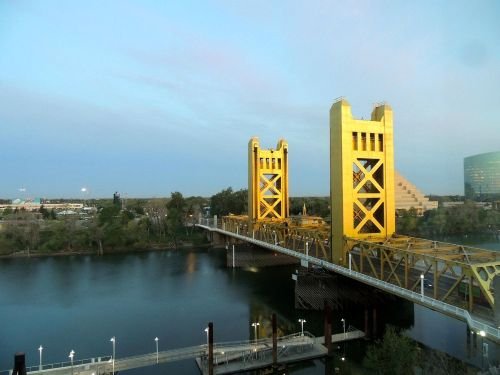
Tower Bridge is Sacramento’s golden welcome mat. Its two 160-foot towers rise over the Sacramento River at the end of Capitol Mall, lined up perfectly with the California State Capitol dome a few blocks away. Dedicated on December 15, 1935, the Streamline Moderne lift bridge was the first vertical lift bridge in California’s state highway system. In 2002, after a public vote among local residents, it was repainted in shimmering metallic gold. It links downtown Sacramento with West Sacramento, and it’s free for drivers, cyclists and walkers.
Tower Bridge Key Facts
| Detail | Information |
| Location | Sacramento River, between Capitol Mall in downtown Sacramento (Sacramento County) and Tower Bridge Gateway in West Sacramento (Yolo County), California |
| Coordinates | Approx. 38.5807° N, 121.5078° W |
| Route | State Route 275 (Capitol Mall to Tower Bridge Gateway) |
| Operator | California Department of Transportation (Caltrans) |
| Bridge type | Vertical lift bridge with a riveted Pratt through truss lift span |
| Style | Streamline Moderne, with steel-sheathed towers |
| Construction began | March 15, 1935 |
| First train crossed | November 7, 1935 |
| Dedicated | December 15, 1935, by Governor Frank Merriam |
| Accepted by the state | January 11, 1936 |
| Original cost | About $994,000 |
| Total length | About 737 ft (225 m) |
| Lift span | About 209 ft, weighing about 1,100 tons |
| Tower height | 160 ft (49 m) |
| Clearance when raised | About 100 ft above high water |
| Navigation channel | About 172 ft wide |
| Lift speed | About 1 ft per second |
| Color | Metallic gold (since 2002); originally silver, then yellow ochre from 1976 |
| Replaced | The 1911 M Street Bridge |
| Award | Honorable mention, AISC Prize Bridge Awards (1935) |
| Historic status | National Register of Historic Places (1982) |
| Toll | None |
| Time zone | Pacific Time: UTC−8 (PST), UTC−7 (PDT, second Sunday in March to first Sunday in November) |
Linking Sacramento and West Sacramento
The Tower Bridge crosses the Sacramento River on the western edge of downtown Sacramento. On the east side, it connects with Capitol Mall, the grand boulevard leading straight to the State Capitol, right beside the historic district of Old Sacramento. On the west side, it lands in West Sacramento, connecting with Tower Bridge Gateway near Sutter Health Park, home of the Sacramento River Cats baseball team.
Because it lines up with Capitol Mall and the Capitol dome, the bridge serves as a ceremonial gateway into California’s capital city. It’s one of the most photographed landmarks in Sacramento.
How the Lift Bridge Works
The Tower Bridge has a movable center section that rises straight up between its two towers to let tall boats pass:
- The bridge is about 737 feet long in total.
- The central lift span is about 209 feet long and weighs about 1,100 tons.
- The two towers rise 160 feet and hide counterweights and chains inside solid steel plates.
- The lift span rises at about one foot per second.
- When fully raised, it gives boats about 100 feet of clearance above high water, through a navigation channel about 172 feet wide.
The steel sheathing on the towers gives the bridge its smooth, streamlined look, a hallmark of 1930s Art Deco design. That same year, the American Institute of Steel Construction gave the bridge an honorable mention in its Prize Bridge Awards.
Free to Cross
There’s no toll on the Tower Bridge. Tips for visiting:
- Drivers can cross between downtown Sacramento and West Sacramento on the Capitol Mall approach.
- Pedestrians and cyclists can use the bridge’s walkways, which were widened in late 2007. The walk across takes only a few minutes.
- Baseball fans often walk across the bridge from downtown to River Cats games at Sutter Health Park.
- Photographers love sunset, when the gold paint glows, and nighttime, when the towers are lit.
- On occasion, the lift span rises for tall vessels, a fun sight to watch from the riverfront.
Replacing the M Street Bridge
Before the Tower Bridge, the Sacramento River crossing here was the M Street Bridge, a steel swing bridge built in 1911 that carried both cars and trains. Between 1910 and 1935, Sacramento’s population more than doubled, and the old bridge couldn’t keep up with the traffic.
Work moved quickly. The old bridge was dismantled by March 11, 1935, and construction of the new bridge began just four days later, on March 15, 1935. The project created about 1,500 jobs during the Great Depression. It was funded by the state, the City and County of Sacramento and the federal government.
The first train crossed the new bridge on November 7, 1935. On December 15, 1935, Governor Frank Merriam dedicated it at a ceremony on M Street and led the inaugural parade across. A large crowd watched the lift span rise for the first time. The state formally accepted the bridge on January 11, 1936, making it the first vertical lift bridge in California’s highway system.
Originally, the roadway had single lanes for cars on either side of a central track for interurban trains, the Sacramento Northern Railway.
A Bridge of Many Colors
The Tower Bridge has changed its look over the decades:
- 1935: It was first painted a silver aluminum color.
- 1976: It was repainted a yellow ochre to match the gold-leafed Capitol dome.
- 2002: Caltrans held a public vote for residents within a 35-mile radius. The choices were all gold; green, gold and silver; or burgundy, silver and gold. All gold won, and the bridge was repainted in its current metallic gold.
In its first 86 years, the bridge was painted only three times.
Celebrations on the Bridge
As the centerpiece of Sacramento’s riverfront, the Tower Bridge has hosted many special events. It has served as a spectacular setting for the Tower Bridge Dinner, a celebration of Sacramento’s role as “America’s Farm-to-Fork Capital,” with long dinner tables set right on the bridge deck. It’s also a favorite backdrop for festivals, fireworks and community gatherings along the river.
Things to Do Nearby
- Old Sacramento State Historic Park, beside the bridge’s east end, has Gold Rush-era buildings, shops and restaurants.
- The California State Railroad Museum, in Old Sacramento, showcases historic locomotives and railroad history.
- The California State Capitol, at the far end of Capitol Mall, offers free tours and beautiful gardens.
- Sutter Health Park, across the river in West Sacramento, hosts minor league baseball games.
- The Sacramento Riverfront Promenade offers walking and biking paths along the river.
FAQs
Q1. Is there a toll on the Tower Bridge in Sacramento?
A. No. The Tower Bridge is free to cross.
Q2. How long is the Tower Bridge?
A. The Tower Bridge is approximately 737 feet long, with a 209-foot lift span.
Q3. How tall is the Tower Bridge?
A. The bridge’s two distinctive towers rise approximately 160 feet.
Q4. When was the Tower Bridge built?
A. Construction began on March 15, 1935, and the Tower Bridge was dedicated on December 15, 1935.
Q5. Why is the Tower Bridge gold?
A. In 2002, local residents voted for an all-gold color scheme in a public survey conducted by Caltrans.
Q6. Does the Tower Bridge still lift?
A. Yes. The Tower Bridge remains a vertical-lift bridge. Its center span can be raised to provide boats with approximately 100 feet of clearance.
Q7. What does the Tower Bridge connect?
A. The bridge connects Capitol Mall in downtown Sacramento with West Sacramento, crossing the Sacramento River.
Q8. Can you walk across the Tower Bridge?
A. Yes. The Tower Bridge has walkways on both sides that are open to pedestrians and cyclists.
Q9. Is the Tower Bridge on the National Register of Historic Places?
A. Yes. The Tower Bridge was added to the National Register of Historic Places in 1982.
Q10. What did the Tower Bridge replace?
A. The Tower Bridge replaced the 1911 M Street Bridge, which was a steel swing bridge across the Sacramento River.


Post Comment