George Washington Memorial Bridge, Seattle, WA: Location, Length, Height, Toll, History & Facts
George Washington Memorial Bridge opened on February 22, 1932, the 200th birthday of the president it’s named for. Thousands of Seattleites crowded onto the deck for the celebration. Most people in Seattle know it simply as the Aurora Bridge, after Aurora Avenue, the highway it carries. The tall steel cantilever bridge rises 167 feet above the west end of Lake Union, linking the Queen Anne and Fremont neighborhoods. A time capsule sealed into the bridge on opening day is set to be opened in 2032, its centennial year. Under its north end lives the Fremont Troll, one of Seattle’s most beloved works of public art. Crossing the bridge is free.
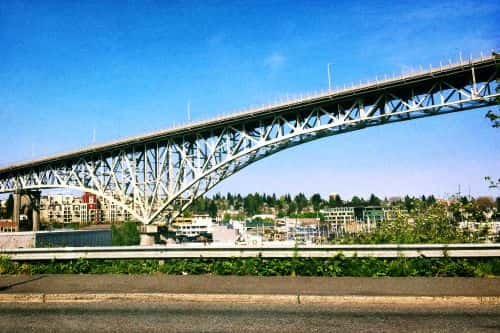
George Washington Memorial Bridge Key Facts
| Detail | Information |
| Common name | Aurora Bridge |
| Location | West end of Lake Union and the Lake Washington Ship Canal, between Queen Anne (south) and Fremont (north), Seattle, Washington |
| Coordinates | Approx. 47.6467° N, 122.3475° W |
| Highway | State Route 99 (Aurora Avenue North), formerly US Route 99 |
| Owner/operator | Washington State Department of Transportation (WSDOT) |
| Bridge type | Steel cantilever and truss bridge |
| Designers | Jacobs and Ober (engineers Joseph Jacobs and Ralph Ober) |
| Steelwork | United States Steel Products Corporation |
| Construction | Piers began in 1929; steelwork from 1931 to February 1932 |
| Opened and dedicated | February 22, 1932 (George Washington’s 200th birthday) |
| Total length | 2,945 ft (898 m) |
| Width | 70 ft (21 m) |
| Height above the water | 167 ft (51 m) |
| Cantilever spans | Two spans of 325 ft each, with a suspended center section |
| Lanes | 6 |
| Weekday traffic | More than 65,000 vehicles |
| Time capsule | Sealed in 1932; planned to be opened in 2032 |
| Historic status | National Register of Historic Places (July 16, 1982) |
| Famous neighbor | The Fremont Troll (1990), under the north end |
| Toll | None |
| Time zone | Pacific Time: UTC−8 (PST), UTC−7 (PDT, second Sunday in March to first Sunday in November) |
High Above Lake Union
The George Washington Memorial Bridge crosses the west end of Lake Union, where the lake narrows into the Lake Washington Ship Canal and the Fremont Cut. On the south side, it begins in the Queen Anne neighborhood. On the north side, it lands in Fremont, a quirky, artsy neighborhood known for its public art, cafés and Sunday market.
From the bridge, travelers see houseboats and sailboats on Lake Union, the Seattle skyline to the south and the Olympic Mountains to the west on clear days. Just to the west, the much lower Fremont Bridge, a 1917 drawbridge, crosses the Fremont Cut.
The Numbers Behind the Bridge
The George Washington Memorial Bridge is a steel cantilever bridge. Two cantilever spans of 325 feet each reach toward the middle of the channel, with a suspended section linking them, like a clothesline hung between two supports. Anchor spans and approaches carry the roadway to each shore.
- The bridge is 2,945 feet long, more than half a mile.
- It’s 70 feet wide and carries six lanes of traffic.
- The deck stands 167 feet above the water, high enough for tall ships to pass beneath.
- When it was built, it was one of the longest steel cantilever bridges in Washington state.
It was designed by Seattle engineers Joseph Jacobs and Ralph Ober of the firm Jacobs and Ober, and the steel was supplied and erected by the United States Steel Products Corporation.
Free to Cross
There’s no toll on the George Washington Memorial Bridge. Tips for visiting:
- Drivers use the bridge as part of State Route 99, one of Seattle’s busiest north–south routes.
- Pedestrians can use the sidewalks on the bridge, which have great views of Lake Union and the city.
- The best views of the bridge come from below, including Gas Works Park on the north shore of Lake Union and the Fremont neighborhood.
- On the water, kayakers and boat tours on Lake Union get a dramatic look up at the steel trusses.
Building the Final Link of US 99
In the 1920s, the Pacific Highway, later US Route 99, ran from Canada to Mexico, but in Seattle traffic had to cross the busy ship canal on low drawbridges like the Fremont Bridge, which often opened for boats. Residents of Fremont and Wallingford lobbied for years for a high-level bridge that would let traffic flow without waiting.
The state chose a route over the west end of Lake Union. Work on the piers began in 1929, and steelwork started in 1931. When the bridge was finished, it completed the final link of US 99 through Seattle, giving the Pacific Coast a continuous highway from Canada to Mexico.
A Grand Opening
The bridge opened on February 22, 1932, timed to mark the 200th anniversary of George Washington’s birth. Thousands of people gathered at both ends, waiting for the signal to rush onto the deck.
The celebration had some memorable touches:
- President Herbert Hoover pressed a key in Washington, D.C., to unfurl a giant American flag on the bridge.
- The base of that ceremonial key was made of Alaskan marble set with 22 gold nuggets found in the Yukon by prospector George Washington Carmack, one of the men credited with discovering the Klondike Gold Rush.
- Caroline McGilvra Burke, widow of Seattle pioneer Judge Thomas Burke, sealed a time capsule into the bridge with messages from 1932 Seattle residents to people 100 years in the future. It’s planned to be opened in 2032.
After the signal, the crowds poured across, and the bridge soon became a mass of celebrating Seattleites.
The Fremont Troll
Beneath the bridge’s north end lives one of Seattle’s most famous residents: the Fremont Troll. Created in 1990 by artists Steve Badanes, Will Martin, Donna Walter and Ross Whitehead, the 18-foot concrete troll grips a real Volkswagen Beetle in one hand, as if he just grabbed it from the road above. The troll was the winner of a Fremont Arts Council contest to bring new life to the space under the bridge.
The troll quickly became an icon of the Fremont neighborhood and one of the most photographed sights in Seattle. In 2005, the street leading to it was renamed Troll Avenue North. Visitors are welcome to climb on the troll for photos.
A Historic Landmark
The George Washington Memorial Bridge was added to the National Register of Historic Places on July 16, 1982, and is also listed on Washington’s state historic register. Today it carries more than 65,000 vehicles on a typical weekday and remains one of the most recognizable bridges in Seattle.
Things to Do Nearby
- The Fremont Troll, under the bridge’s north end, is a must-see photo stop.
- Gas Works Park, on the north shore of Lake Union, has striking views of the bridge and the Seattle skyline.
- The Fremont Sunday Market offers vintage finds, crafts and food.
- The Burke-Gilman Trail runs along the ship canal near the bridge, perfect for walking and biking.
- Woodland Park Zoo, a short drive north on Aurora Avenue, is one of Seattle’s top family attractions.
FAQs
Q1. Is there a toll on the George Washington Memorial Bridge?
A. No. The George Washington Memorial Bridge is free to cross.
Q2. Why is it called the Aurora Bridge?
A. It carries Aurora Avenue North (State Route 99), so most Seattleites call it the Aurora Bridge.
Q3. How long is the George Washington Memorial Bridge?
A. It’s 2,945 feet long and 70 feet wide.
Q4. How high is the George Washington Memorial Bridge?
A. The deck stands 167 feet above the water.
Q5. When did the George Washington Memorial Bridge open?
A. It opened on February 22, 1932, George Washington’s 200th birthday.
Q6. Is there a time capsule in the Aurora Bridge?
A. Yes. A time capsule sealed in 1932 is planned to be opened in 2032.
Q7. What is under the Aurora Bridge?
A. The Fremont Troll, a giant concrete sculpture holding a real Volkswagen Beetle, lives under the bridge’s north end.
Q8. Can you walk across the Aurora Bridge?
A. Yes. The bridge has sidewalks for pedestrians.
Q9. Who designed the George Washington Memorial Bridge?
A. It was designed by Seattle engineers Joseph Jacobs and Ralph Ober.
Q10. Is the George Washington Memorial Bridge a historic landmark?
A. Yes. It was added to the National Register of Historic Places in 1982.


Post Comment