Faust Street Bridge, New Braunfels, TX: Location, Length, Height, Toll, History & Facts
Faust Street Bridge has carried travelers across the Guadalupe River in New Braunfels since 1887, and from 1917 it was the main crossing on the road between Austin and San Antonio. Built by the King Iron Bridge Company of Ohio, the long iron truss bridge is one of the last wrought-iron bridges built in Texas. It was also one of the first long-term toll-free crossings of a major river in the state. Today it’s a peaceful pedestrian and bike bridge, a Recorded Texas Historic Landmark, and listed on the National Register of Historic Places. It’s free to visit and walk across.
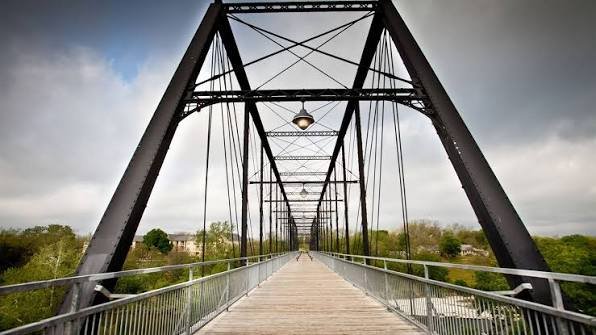
Faust Street Bridge Key Facts
| Detail | Information |
| Other names | Guadalupe River Bridge, Milltown Bridge, Mill Bridge |
| Location | Guadalupe River, connecting Faust Street and Porter Street, New Braunfels, Comal County, Texas |
| Coordinates | Approx. 29.6967° N, 98.1069° W |
| Builder | King Iron Bridge Company of Ohio |
| Contracted by | Comal County Commissioners Court |
| Built | 1887 |
| Material | Wrought iron |
| Bridge type | Pin-connected through truss bridge combining Pratt and Whipple truss designs |
| Total length | More than 640 ft (195 m) |
| Highway role | Main crossing on State Highway 2 between Austin and San Antonio, from 1917 |
| Replaced as a highway crossing | 1934, by a new concrete bridge nearby |
| Current use | Pedestrians and cyclists only |
| Texas landmark | Recorded Texas Historic Landmark (1999) |
| National Register | Listed March 17, 2009 |
| Distinction | One of the last wrought-iron bridges built in Texas; one of the first long-term toll-free crossings of a major Texas river |
| Toll | None |
| Time zone | Central Time: UTC−6 (CST), UTC−5 (CDT, second Sunday in March to first Sunday in November) |
On the Guadalupe in New Braunfels
The Faust Street Bridge crosses the Guadalupe River on the east side of New Braunfels, a short distance from where the spring-fed Comal River joins the Guadalupe. It connects Faust Street on the west bank with Porter Street on the east bank, a few blocks from downtown and close to Interstate 35.
From the middle of the bridge, visitors get a peaceful view up the Guadalupe toward a historic dam and the river’s tree-lined banks. Paths lead down from the bridge to the water’s edge, and the spot is popular with anglers.
A Rare Iron Truss
The Faust Street Bridge is a through truss bridge. Its roadway runs through a framework of iron beams that rise above and around the deck.
- The bridge is more than 640 feet long, a monumental length for an iron bridge of its era.
- It’s built of wrought iron, a material that was soon replaced by steel in bridge building. That makes it one of the last wrought-iron bridges built in Texas.
- Its pieces are joined with large pins rather than rivets or welds, a common technique of the late 1800s.
- It combines two truss designs: the Pratt truss, widely used in the 19th century, and the Whipple truss, a stronger version with extra diagonal members that crisscross across two panels.
The Whipple design enjoyed a brief but intense period of popularity in the mid- to late 1800s, so surviving examples like this one are an important part of America’s engineering history.
Free to Visit
There’s no toll or fee to walk or bike across the Faust Street Bridge. Tips for visiting:
- The bridge is open to pedestrians and cyclists only. Cars aren’t allowed.
- Parking is available near the end of Faust Street, which dead-ends at the bridge.
- A Texas Historical Commission marker on the bridge tells its story.
- The walk across takes only a few minutes, but it’s worth lingering for photos of the iron trusses and the river.
- Early morning and sunset are great times to visit, when the light falls across the ironwork.
An Old Crossing on El Camino Real
People have crossed the Guadalupe here for centuries. In the 1700s, caravans carrying supplies to Spanish missions in East Texas, along with many other travelers, crossed the river near this site on El Camino Real, the King’s Highway.
New Braunfels itself was founded in 1845 by German settlers led by Prince Carl of Solms-Braunfels. As the town grew, travelers and freight wagons needed a dependable way across the Guadalupe, especially when the river rose after heavy rains.
Building the Bridge in 1887
In 1887, the Comal County Commissioners Court contracted with the King Iron Bridge Company of Ohio to build a high-water bridge over the Guadalupe River. King Iron Bridge was one of the most active bridge companies in America at the time, shipping prefabricated iron parts by rail to be assembled on site.
The new bridge rose high enough to stay usable during floods, giving New Braunfels a reliable crossing year-round. It was also built as a free public bridge, one of the first long-term toll-free structures over a major waterway in Texas, at a time when many river crossings still charged tolls.
A Highway Between Austin and San Antonio
In 1917, the Texas Highway Department chose the Faust Street Bridge as a major crossing for all traffic between Austin and San Antonio on State Highway 2, the route that had earlier served as the Austin–San Antonio post road. For years, cars, trucks and travelers heading between the two cities crossed the Guadalupe on its iron deck.
In 1934, a new concrete highway bridge was built nearby to handle growing traffic, and the Faust Street Bridge went back to serving local traffic. It carried cars until 1979 and later reopened as a crossing for walkers and cyclists.
Landmark Recognition
The Faust Street Bridge’s historic and engineering importance has been formally recognized:
- In 1999, the Texas Historical Commission designated it a Recorded Texas Historic Landmark and placed a marker on the bridge.
- On March 17, 2009, it was listed on the National Register of Historic Places as part of the Historic Bridges of Texas collection.
Its unusual mix of Pratt and Whipple truss types, combined with its wrought-iron construction, places it among the most important historic bridges in Texas.
Things to Do Nearby
- Historic Gruene, a few miles north, has Gruene Hall, the oldest continually operating dance hall in Texas, along with shops and restaurants.
- Landa Park, near downtown, has spring-fed pools, gardens and the headwaters of the Comal River.
- The Comal and Guadalupe rivers are famous for tubing, kayaking and swimming in the summer.
- The Sophienburg Museum tells the story of New Braunfels’s German founders.
- Wurstfest, held each November, celebrates the city’s German heritage with food, music and dancing.
FAQs
Q1. Is there a toll on the Faust Street Bridge?
A. No. The Faust Street Bridge is free for pedestrians and cyclists.
Q2. How long is the Faust Street Bridge?
A. It’s more than 640 feet long.
Q3. When was the Faust Street Bridge built?
A. It was built in 1887 by the King Iron Bridge Company of Ohio.
Q4. Can you drive across the Faust Street Bridge?
A. No. It’s open only to pedestrians and cyclists.
Q5. What river does the Faust Street Bridge cross?
A. It crosses the Guadalupe River in New Braunfels, Texas.
Q6. What type of bridge is the Faust Street Bridge?
A. It’s a wrought-iron, pin-connected through truss bridge that combines Pratt and Whipple truss designs.
Q7. Is the Faust Street Bridge a historic landmark?
A. Yes. It’s a Recorded Texas Historic Landmark (1999) and is listed on the National Register of Historic Places (2009).
Q8. Why was the Faust Street Bridge important?
A. From 1917, it was the main crossing between Austin and San Antonio on State Highway 2.
Q9. What are the other names for the Faust Street Bridge?
A. It has also been called the Guadalupe River Bridge, the Milltown Bridge and the Mill Bridge.
Q10. Where is the Faust Street Bridge?
A. It connects Faust Street and Porter Street across the Guadalupe River on the east side of New Braunfels.




Post Comment