4th Street Bridge, Los Angeles, CA: Location, Length, Height, Toll, History & Facts
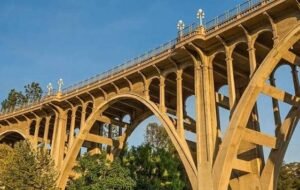
4th Street Bridge looks as if it was borrowed from a European cathedral. Its concrete railings are carved with Gothic trefoil patterns, its center piers have pointed lancet arches, and its paired lamp posts look like something from a medieval town square. The bridge was built in 1931 and carries Fourth Street across the Los Angeles River between downtown’s Arts District and Boyle Heights. It replaced the last wooden bridge over the river downtown, and it’s one of only two Los Angeles River bridges designed in a Period Revival style rather than the more common Beaux-Arts look. Officially the Fourth Street Viaduct, it’s a Los Angeles Historic-Cultural Monument, and it’s free to cross.
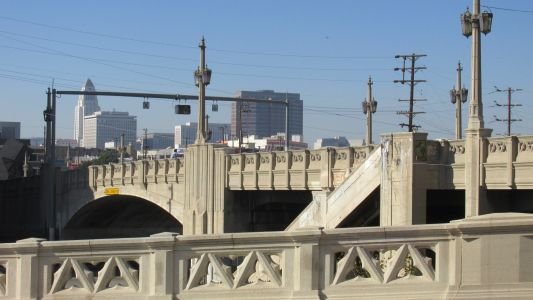
4th Street Bridge Key Facts
| Detail | Information |
| Official name | Fourth Street Viaduct |
| Location | Over the Los Angeles River and rail lines, between the Arts District (downtown Los Angeles) and Boyle Heights, California |
| Coordinates | Approx. 34.0436° N, 118.2257° W |
| Road | 4th Street |
| Owner | City of Los Angeles |
| Bridge type | Reinforced concrete viaduct with a central open-spandrel arch over the river |
| Engineer | Merrill Butler, Los Angeles city engineer of bridges and structures |
| Built | 1931 |
| Replaced | The last remaining wooden bridge over the river downtown |
| Total length | About 1,837 ft (almost half a mile) |
| River span | About 254 ft (central arch) |
| Architectural style | Gothic Revival details (porticos, railings, lamp posts), with Beaux-Arts influences in its towers |
| Special features | Lancet-arch openings on the central piers, trefoil-pattern railings, paired Gothic light fixtures and built-in pedestrian seating |
| Documentation | Recorded by the Historic American Engineering Record, including its original and retrofit engineering |
| Historic status | Los Angeles Historic-Cultural Monument No. 906 (2008) |
| Toll | None |
| Time zone | Pacific Time: UTC−8 (PST), UTC−7 (PDT, second Sunday in March to first Sunday in November) |
Between the Arts District and Boyle Heights
The 4th Street Bridge crosses the concrete channel of the Los Angeles River just east of downtown, a few blocks north of the Sixth Street Viaduct. On the west side, it begins in the Arts District, a neighborhood of converted warehouses, galleries, cafés and creative studios, close to the Southern California Institute of Architecture (SCI-Arc). On the east side, it reaches Boyle Heights, one of the city’s oldest and most culturally rich neighborhoods.
Along its almost half-mile length, the bridge also passes over railroad tracks and industrial areas on both sides of the river. From its sidewalks, there are great views of the downtown skyline and the glowing arches of the Sixth Street Viaduct.
A Gothic Bridge on the LA River
Most of the great bridges built over the Los Angeles River in the 1920s and 1930s followed Beaux-Arts or Classical designs. The 4th Street Bridge stands out with its Gothic Revival details:
- Porticos and piers: Two pairs of massive central piers feature pointed lancet-arch openings, like the windows of a Gothic church.
- Railings: The concrete railings are sculpted with incised trefoil (three-lobed) patterns set in triangular forms.
- Lamp posts: Low pylons hold fluted lamp posts topped with paired Gothic-style light fixtures.
- Seating: Several piers include built-in benches for pedestrians, an unusual and charming feature.
- Towers: Its four concrete towers show Beaux-Arts influences, blending styles in a distinctive way.
Along the western section of the bridge, the deck splits into two roadways, another unusual feature of its design.
Length and Structure
The 4th Street Bridge is a reinforced concrete viaduct with a mix of span types:
- The total length is about 1,837 feet, almost half a mile.
- Several sections rest on vertical piers with closed-spandrel barrel arch spans.
- The central span over the river is a 254-foot open-spandrel arch, where the deck is supported by columns rising from the arch.
- Builders used temporary reinforced concrete hinges during construction of the river arch, a technique that helped control stresses as the concrete set.
The bridge has since been seismically retrofitted. Its original engineering and the retrofit work were both documented by the Historic American Engineering Record.
Free to Cross
There’s no toll on the 4th Street Bridge. Tips for visiting:
- Drivers use the bridge as a direct link between downtown and Boyle Heights.
- Pedestrians can walk along the sidewalks to see the Gothic details up close and rest on the built-in benches.
- Photographers will find great angles from the bridge toward the Sixth Street Viaduct and the downtown skyline, especially around sunset.
- Combine a visit with the Sixth Street Viaduct, a few blocks south, to compare a 1931 landmark with a 2022 one.
Merrill Butler, LA’s Bridge Builder
The 4th Street Bridge was built under Merrill Butler, who served as the City of Los Angeles’ engineer of bridges and structures from the 1920s into the early 1960s. Remarkably, Butler learned engineering through a correspondence course. He went on to design or oversee many of the monumental concrete bridges that cross the Los Angeles River, including the original Sixth Street Viaduct.
Butler’s bridges were inspired by the City Beautiful movement, which believed public works should be both useful and beautiful. Each of his river bridges was given its own decorative style, so no two look exactly alike.
Replacing the Last Wooden Bridge
When the 4th Street Bridge was built in 1931, it replaced the last remaining wooden bridge across the Los Angeles River downtown. At the time, Los Angeles was growing rapidly, and the city was replacing older wooden and iron bridges with strong reinforced concrete viaducts that could handle cars, trucks and streetcars, and that could rise above the railroad yards along the river.
The 4th Street Bridge was one of the last of these grand river bridges to be completed, and some historians call it the most elaborate of them all.
A Recognized Landmark
The Los Angeles River bridges form one of the largest groups of historically significant bridges in the United States. In 2007, the city’s Cultural Heritage Commission recognized many of them, and in 2008 the 4th Street Bridge was declared Los Angeles Historic-Cultural Monument No. 906. Artists have also celebrated it. In 2018, a gallery exhibition titled “Positively 4th Street” featured paintings, drawings and writing inspired by the bridge.
Things to Do Nearby
- The Sixth Street Viaduct, a few blocks south, is a modern landmark with glowing arches and a new park below.
- The Arts District has galleries, murals, breweries and popular restaurants.
- SCI-Arc, the Southern California Institute of Architecture, occupies a long former freight depot near the bridge.
- Mariachi Plaza in Boyle Heights is a cultural landmark and gathering place for musicians.
- Little Tokyo, just west of the Arts District, offers Japanese shops, restaurants and museums.
FAQs
Q1. Is there a toll on the 4th Street Bridge in Los Angeles?
No. The 4th Street Bridge is free to cross.
Q2. How long is the 4th Street Bridge?
It’s about 1,837 feet long, almost half a mile.
Q3. When was the 4th Street Bridge built?
It was built in 1931.
Q4. What style is the 4th Street Bridge?
It features Gothic Revival details, including pointed arches, trefoil-pattern railings and Gothic lamp posts.
Q5. Who designed the 4th Street Bridge?
It was built under Merrill Butler, the city’s engineer of bridges and structures.
Q6. What does the 4th Street Bridge connect?
It connects downtown Los Angeles’ Arts District with Boyle Heights across the Los Angeles River.
Q7. Is the 4th Street Bridge a historic landmark?
Yes. It was declared Los Angeles Historic-Cultural Monument No. 906 in 2008.
Q8. Can you walk across the 4th Street Bridge?
Yes. Sidewalks run along the bridge, and several piers include built-in benches.
Q9. What did the 4th Street Bridge replace?
It replaced the last remaining wooden bridge over the Los Angeles River downtown.
Q10. What is the official name of the 4th Street Bridge?
It’s officially called the Fourth Street Viaduct.


Post Comment