Rio Grande Gorge Bridge, Taos, NM: Location, Length, Height, Toll, History & Facts
Rio Grande Gorge Bridge seems to appear out of nowhere. Driving west from Taos on US Highway 64, the flat sagebrush plain suddenly drops away into a sheer volcanic canyon, and a slender steel bridge carries the road across it, hundreds of feet above the Rio Grande. While it was being built, locals nicknamed it the “bridge to nowhere,” because there wasn’t yet money to continue the road on the far side. Dedicated on September 10, 1965, it went on to win the American Institute of Steel Construction’s award as the “Most Beautiful Steel Bridge” in the long-span category. Today it’s one of the most visited landmarks in northern New Mexico, and it’s free to cross on foot or by car.
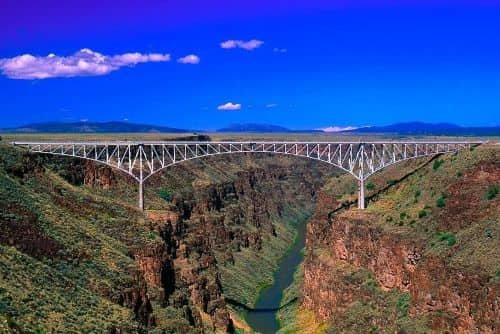
Rio Grande Gorge Bridge Key Facts
| Detail | Information |
| Local names | The Gorge Bridge; the High Bridge |
| Location | Rio Grande Gorge, about 10 miles northwest of Taos, New Mexico |
| Coordinates | Approx. 36.4772° N, 105.7330° W |
| Highway | US Route 64 |
| Bridge type | Three-span steel continuous deck truss (cantilever truss) with a concrete-filled steel-grid deck |
| Construction | 1963–1965 |
| Topping out | March 26, 1965 |
| Dedicated | September 10, 1965 |
| Total length | About 1,280 ft (390 m) |
| Spans | Main span of 600 ft, two 300-ft side spans, plus short approach spans at each end |
| Roadway width | About 28 ft |
| Height above the Rio Grande | About 650 ft (the official 1967 figure); some newer measurements put it closer to 565–600 ft |
| Piers | Each stands about 106 ft tall, topped by about 100 ft of steel trusses up to the roadway |
| Award | AISC “Most Beautiful Steel Bridge,” Long Span category (1966) |
| Viewing areas | Sidewalks with small viewing platforms that extend out over the gorge |
| Parking | Lots on both sides of the bridge |
| Toll | None |
| Time zone | Mountain Time: UTC−7 (MST), UTC−6 (MDT, second Sunday in March to first Sunday in November) |
A Bridge Across a Volcanic Canyon
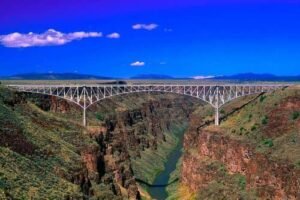
The Rio Grande Gorge is a deep, narrow canyon carved by the Rio Grande through layers of dark volcanic basalt. It’s part of the Rio Grande Rift, a long crack in the earth’s crust, and it cuts across an otherwise flat plain between the Sangre de Cristo Mountains to the east and the Carson National Forest to the west.
The bridge carries US Highway 64 across the gorge about 10 miles northwest of Taos. It sits within the Rio Grande del Norte National Monument, a protected area of canyons, mesas and wildlife habitat. From the bridge, visitors see the river winding far below, framed by dark, sheer canyon walls, with the Sangre de Cristo Mountains on the horizon.
How High and How Long
- The bridge is about 1,280 feet long.
- It has three main truss spans: a 600-foot center span and two 300-foot side spans, plus short steel approach spans at each end.
- The roadway is about 28 feet wide, with sidewalks on both sides.
- Each pier rises about 106 feet from the canyon walls, topped by about 100 feet of steel trusses reaching up to the deck.
The bridge’s height has an interesting twist. When it was listed among the nation’s historic places in 1967, it was recorded as about 650 feet above the Rio Grande, and that figure is still the one most often quoted. In later years, independent measurements suggested the deck may be closer to 565 to 600 feet above the river. Either way, it’s one of the highest bridges in the United States.
Free to Cross
There’s no toll on the Rio Grande Gorge Bridge. Tips for visiting:
- Parking is available in lots on both sides of the bridge. The lot on the west side is usually larger.
- Walking across is the best way to experience the bridge. The sidewalks have small viewing platforms that jut out over the gorge, perfect for photos.
- Wind can be strong on the bridge, so hold on to hats, phones and cameras.
- Wildlife: Look for desert bighorn sheep on the canyon walls near the bridge, and hawks and ravens riding the air currents.
- Local vendors often sell jewelry and crafts in the parking areas.
- Sunrise and sunset paint the canyon walls with warm light and are great times to visit.
Building the “Bridge to Nowhere”
In the early 1960s, New Mexico planned a highway west from Taos across the Rio Grande Gorge to connect with northwestern New Mexico. Construction of the bridge began in 1963. But for a time, there wasn’t enough funding to build the road on the far side of the gorge, so locals jokingly called it the “bridge to nowhere.”
Building a bridge over such a deep canyon required creative engineering. Crews used a high line, a cable system stretched across the gorge, to move the steel members into position. On March 26, 1965, an American flag rode the last piece of structural steel into place in a traditional topping-out ceremony.
The bridge was dedicated on September 10, 1965, with New Mexico Governor Jack Campbell in attendance. The road on the far side was eventually completed, and the “bridge to nowhere” became a key link on US 64.
An Award-Winning Design
In 1966, a year after it opened, the American Institute of Steel Construction named the Rio Grande Gorge Bridge the “Most Beautiful Steel Bridge” in its long-span category. Judges recognized how gracefully the slender steel trusses fit into the rugged landscape. The steel arches taper toward the canyon rims and the center of the bridge, giving it a light, elegant look against the dark basalt walls.
On the Big Screen
The bridge’s dramatic setting has made it a favorite with filmmakers. It has appeared in movies including Natural Born Killers, Twins, She’s Having a Baby, Wild Hogs and Terminator Salvation.
Things to Do Nearby
- Rio Grande del Norte National Monument offers hiking, camping, wildlife viewing and dramatic canyon overlooks.
- The West Rim Trail, starting near the bridge, follows the edge of the gorge with sweeping views.
- Whitewater rafting through the Taos Box is one of the most exciting river trips in the Southwest.
- The Earthship community, west of the bridge, showcases off-grid homes built from recycled materials.
- Taos Pueblo, a UNESCO World Heritage Site, has been continuously lived in for about 1,000 years.
- Historic Taos Plaza has art galleries, shops and restaurants.
FAQs
Q1. Is there a toll on the Rio Grande Gorge Bridge?
A. No. The Rio Grande Gorge Bridge is free to cross.
Q2. How high is the Rio Grande Gorge Bridge?
A. It’s usually listed at about 650 feet above the Rio Grande, though some newer measurements put it closer to 565–600 feet.
Q3. How long is the Rio Grande Gorge Bridge?
A. It’s about 1,280 feet long, with a 600-foot main span.
Q4. When was the Rio Grande Gorge Bridge built?
A. It was built from 1963 to 1965 and dedicated on September 10, 1965.
Q5. Why was it called the bridge to nowhere?
A. While it was being built, there wasn’t funding to continue the road on the far side of the gorge.
Q6. Can you walk across the Rio Grande Gorge Bridge?
A. Yes. Sidewalks and small viewing platforms let visitors walk across and look down into the gorge.
Q7. Where is the Rio Grande Gorge Bridge?
A. It’s on US 64, about 10 miles northwest of Taos, New Mexico.
Q8. Did the Rio Grande Gorge Bridge win any awards?
A. Yes. It won the AISC “Most Beautiful Steel Bridge” award in the long-span category in 1966.
Q9. Is there parking at the Rio Grande Gorge Bridge?
A. Yes. There are parking areas on both sides of the bridge.
Q10. What movies feature the Rio Grande Gorge Bridge?
A. It has appeared in films including Natural Born Killers, Twins, Wild Hogs and Terminator Salvation.







Post Comment