Cabrillo Bridge, San Diego, CA: Location, Length, Height, Toll, History & Facts
Cabrillo Bridge is the grand front door to Balboa Park. Its seven tall concrete arches stride across a deep canyon, about 120 feet above the freeway below, toward the ornate Spanish Colonial Revival towers of the California Building. The bridge was built for the 1915 Panama-California Exposition, and Franklin D. Roosevelt, then Assistant Secretary of the Navy, rode across it at its dedication in April 1914. It was the first multiple-arched cantilever bridge in California. Restored for the exposition’s centennial in 2015, it remains one of San Diego’s most beloved landmarks, and it’s free to cross on foot, by bike or by car.

Cabrillo Bridge Key Facts
| Detail | Information |
| Location | Cabrillo Canyon, Balboa Park, linking Laurel Street (Bankers Hill) with El Prado in San Diego, California |
| Coordinates | Approx. 32.7313° N, 117.1532° W |
| Crosses | Cabrillo Canyon and State Route 163 (Cabrillo Freeway) |
| Bridge type | Multiple-arched reinforced concrete cantilever bridge |
| Designer | Frank P. Allen Jr., director of works for the exposition |
| Built for | 1915 Panama-California Exposition |
| Construction | December 1912 to April 1914 |
| Dedicated | April 1914, with Franklin D. Roosevelt and Mayor Charles F. O’Neill |
| Original cost | About $195,653 |
| Main bridge length | About 450 ft |
| Length with approaches | About 916 ft (some historic records list about 1,505 ft including the full approach roads) |
| Height | About 120 ft to the roadway |
| Arches | 7, each about 56 ft wide, on 14 hollow concrete piers |
| Distinction | First multiple-arched cantilever bridge in California |
| Restoration | 2014–2015 seismic retrofit and rehabilitation for the exposition’s centennial (about $38 million) |
| Awards (restoration) | 2015 ASCE San Diego Outstanding Centennial Historic Engineering Project; 2015 APWA Project of the Year |
| Historic status | Part of the El Prado Complex on the National Register of Historic Places |
| Named for | Juan Rodríguez Cabrillo, the explorer who reached San Diego Bay in 1542 |
| Toll | None |
| Time zone | Pacific Time: UTC−8 (PST), UTC−7 (PDT, second Sunday in March to first Sunday in November) |
The Gateway to Balboa Park
The Cabrillo Bridge crosses Cabrillo Canyon on the western edge of Balboa Park. On the west, it begins at Sixth Avenue and Laurel Street in the Bankers Hill neighborhood. On the east, it leads straight onto El Prado, the park’s main promenade, passing beneath the arch of the West Gate into the heart of the old exposition grounds.
Walking east across the bridge, visitors see the dome and bell tower of the California Building rise ahead, one of San Diego’s most famous views. Below the bridge, State Route 163 winds through the canyon past trees and gardens.
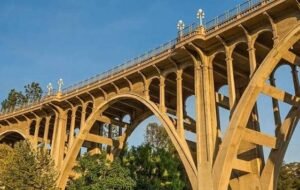
Seven Arches Over the Canyon
The bridge’s simple, elegant design draws on the great arched bridges of Spain and the aqueducts of ancient Rome:
- The main bridge is about 450 feet long, with approaches stretching it to about 916 feet.
- Seven tall semicircular arches, each about 56 feet wide, carry the roadway.
- The arches rest on 14 hollow reinforced concrete piers.
- The roadway sits about 120 feet above the canyon floor at its highest point.
- It was the first multiple-arched cantilever bridge built in California.
The bridge has little ornamentation. Its beauty comes from the rhythm of its seven arches, which some writers have compared to the famous Roman bridge at Alcántara in Spain.
Free to Cross
There’s no toll or fee to cross the Cabrillo Bridge. Tips for visiting:
- Walking across is the best way to enjoy the bridge, with views of the California Tower ahead and the canyon below. The walk takes about five minutes.
- Cyclists can ride across into the park.
- Drivers can cross into the park on El Prado, though the central areas of Balboa Park have been reorganized to favor pedestrians. Check current Balboa Park access and parking information before you go.
- At night, decorative lighting added during the 2015 restoration highlights the arches. It was the first time in the bridge’s history that it was lit for its beauty.
- For photos, try the trails in the canyon below, or the west end of the bridge at sunset.
Building the Exposition Bridge
In 1915, San Diego hosted the Panama-California Exposition to celebrate the opening of the Panama Canal and to show off the city as the first U.S. port of call for ships coming through it. Planners wanted a dramatic entrance to the exposition grounds, which meant crossing deep Cabrillo Canyon on the park’s west side.
Bertram Goodhue, the exposition’s lead architect, proposed a three-arch design, but it was too expensive. The park commissioners instead chose an on-budget design by Frank P. Allen Jr., the exposition’s director of works, with seven arches and cantilevered roadway supports. Construction ran from December 1912 to April 1914 and used more than a million board feet of redwood for forms, at a total cost of about $195,653.
The bridge was dedicated in April 1914. Franklin D. Roosevelt, then Assistant Secretary of the Navy, was driven across it with San Diego Mayor Charles F. O’Neill in the inaugural crossing. In its first two years, the bridge was mostly reserved for pedestrians, with special exceptions for dignitaries. Roosevelt returned in 1935, this time as President of the United States, to cross the bridge again for Balboa Park’s second world’s fair, the California Pacific International Exposition.
From Lagoon to Freeway
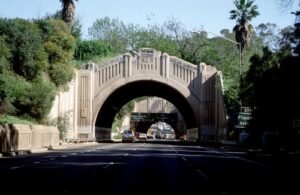
When the bridge was built, a shallow pond, sometimes called a lagoon, lay in Cabrillo Canyon beneath it. In 1948, the pond was removed to make way for the Cabrillo Freeway, now State Route 163. The bridge’s tall, wide arches turned out to be a perfect fit for the four-lane highway passing beneath. Today, drivers on SR 163 enjoy a striking view looking up at the arches as they pass through the park.
Restored for the Centennial
To prepare for the 100th anniversary of the Panama-California Exposition in 2015, Caltrans and the City of San Diego completed a major rehabilitation and seismic retrofit of the bridge, at a cost of about $38 million.
- The retrofit work was kept inside the hollow piers and deck, preserving the bridge’s historic appearance.
- The deck was restored to match its original color and texture.
- New architectural lighting was added to highlight the arches at night.
- The deck work was finished in spring 2014, ahead of the centennial celebrations.
The project won the 2015 Outstanding Centennial Historic Engineering Project Award from the San Diego chapter of the American Society of Civil Engineers and the 2015 Project of the Year Award from the regional chapter of the American Public Works Association.
Things to Do Nearby
- The California Tower and Museum of Us, just east of the bridge, offer exhibits and guided tower climbs with panoramic views.
- The San Diego Museum of Art, the Timken Museum and many other museums line El Prado.
- The Botanical Building and Lily Pond are among the most photographed spots in Balboa Park.
- The San Diego Zoo, at the north end of Balboa Park, is world famous.
- The Alcazar Garden and Spanish Village Art Center showcase gardens, tiles and local artists.
FAQs
Q1. Is there a toll on the Cabrillo Bridge?
A. No. The Cabrillo Bridge is free to cross.
Q2. How long is the Cabrillo Bridge?
A. The main bridge is about 450 feet long, and about 916 feet including approaches.
Q3. How high is the Cabrillo Bridge?
A. The roadway sits about 120 feet above the canyon floor.
Q4. When was the Cabrillo Bridge built?
A. It was built from December 1912 to April 1914 for the 1915 Panama-California Exposition.
Q5. Who dedicated the Cabrillo Bridge?
A. Franklin D. Roosevelt, then Assistant Secretary of the Navy, took part in the inaugural crossing in April 1914.
Q6. Who designed the Cabrillo Bridge?
A. It was designed by Frank P. Allen Jr., director of works for the exposition.
Q7. What is under the Cabrillo Bridge?
A. State Route 163, the Cabrillo Freeway, runs through the canyon beneath the bridge.
Q8. Can you walk across the Cabrillo Bridge?
A. Yes. Walking is one of the best ways to enjoy the bridge and its views of Balboa Park.
Q9. Who is the Cabrillo Bridge named after?
A. It’s named for Juan Rodríguez Cabrillo, the explorer who sailed into San Diego Bay in 1542.
Q10. When was the Cabrillo Bridge restored?
A. It was rehabilitated and seismically retrofitted in 2014–2015, in time for the exposition’s centennial.


Post Comment