Manhattan Bridge, New York, NY: Location, Length, Height, Toll, History & Facts
The Manhattan Bridge carries more people on subway trains than in cars. On a typical weekday, NYC DOT counts more than 450,000 people crossing it, and over three-quarters of them are riding the B, D, N or Q trains on its four rail tracks. The bridge opened on December 31, 1909, between the Brooklyn and Williamsburg bridges, linking Chinatown in Lower Manhattan with DUMBO and Downtown Brooklyn. It gets less attention than its famous neighbor, but it earned its own place in engineering history. It was the first major suspension bridge designed with deflection theory, the method that later made much longer and lighter spans possible.
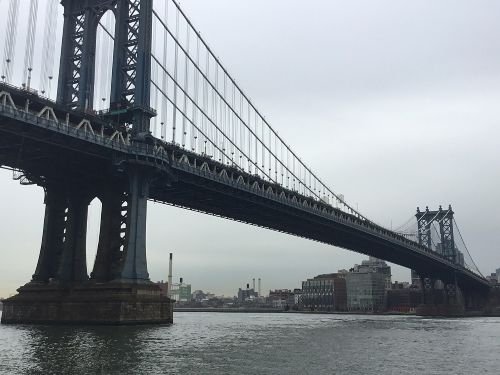
Manhattan Bridge Quick Facts
| Detail | Information |
| Location | East River, between Chinatown/Lower Manhattan and DUMBO/Downtown Brooklyn, New York City, NY, USA |
| Coordinates | Approx. 40.7070° N, 73.9905° W |
| Manhattan entrance | Canal Street and the Bowery |
| Brooklyn entrance | Flatbush Avenue Extension (walkway and bikeway near Jay Street and Sands Street) |
| Bridge type | Suspension bridge |
| Designer | Leon Moisseiff |
| Builder | Phoenix Bridge Company |
| Construction | 1901–1909 |
| Opened | December 31, 1909 |
| Original cost | About $31 million |
| Operator | New York City Department of Transportation (NYC DOT) |
| Main span | 1,470 ft (448 m) |
| Length, lower level (abutment to abutment) | 5,780 ft (1,762 m) |
| Length, upper roadways (portal to portal) | 6,090 ft (1,856 m) |
| Tower height | About 336 ft (102 m) |
| Main cables | 4, each 3,224 ft (983 m) long |
| Vehicle lanes | 7 (4 on the upper level, 3 on the lower level) |
| Subway tracks | 4 (B, D, N and Q trains) |
| Pedestrian walkway | South side |
| Bike path | North side (separate, opened 2004) |
| Weekday crossings (NYC DOT) | 450,000+ people, including about 85,400 vehicles and 340,900 subway riders |
| Toll | None |
| Manhattan arch and colonnade | Designed by Carrère and Hastings; completed in 1916; NYC Landmark since 1975 |
| Engineering recognition | National Historic Civil Engineering Landmark (2009) |
| Time zone | Eastern Time: UTC−5 (EST), UTC−4 (EDT, second Sunday in March to first Sunday in November) |
Between Chinatown and DUMBO
The Manhattan end lands at Canal Street and the Bowery, right in the middle of Chinatown. You can’t miss the entrance: a 73-foot stone arch flanked by a curved row of columns, facing a busy intersection full of dumpling shops and bakeries. The pedestrian walkway starts just beside it, on the south side.
On the Brooklyn side, the bridge comes down onto the Flatbush Avenue Extension. It passes over DUMBO, the neighborhood whose name stands for “Down Under the Manhattan Bridge Overpass.” The walkway and bike path both come out near Jay and Sands Streets. From there it’s about a five-minute walk to Brooklyn Bridge Park and the Washington Street photo spot, where the bridge’s blue steel frames the Empire State Building between two rows of old brick warehouses. That shot was made famous by the poster for the 1984 film Once Upon a Time in America, and on a weekend morning you’ll see dozens of people lined up to recreate it.
Measuring a Two-Level Bridge
The length depends on which deck you measure, because the bridge has two levels. The lower level runs 5,780 feet between its abutments. The upper roadways stretch 6,090 feet from portal to portal, since their ramps climb farther inland. Either way, the part over the river, between the two towers, is 1,470 feet.
The towers rise about 336 feet, making them noticeably taller than the Brooklyn Bridge’s granite towers downstream. Unlike those, they are made entirely of steel. Four main cables, each 3,224 feet long, carry a deck that holds more kinds of traffic than almost any other bridge in the city:
- Four lanes of traffic on the upper level, two in each direction.
- Three lanes on the lower level, which change direction depending on the time of day.
- Four subway tracks, two on each side of the bridge.
- A pedestrian walkway on the south side and a separate bike path on the north side.
When it opened, the main span was the third longest of any suspension bridge in the world, and it kept that ranking until 1924.
Free to Cross, With a Few Things Drivers Should Know
There’s no toll on the Manhattan Bridge in either direction. It’s one of four city-run East River crossings, along with the Brooklyn, Williamsburg and Queensboro bridges, and none of them charge.
Because it’s free, a lot of drivers use it, so a few practical points help:
- It’s usually the better choice for commercial traffic, since trucks are banned on the Brooklyn Bridge. Height and weight rules still apply, so check NYC DOT’s truck route map first.
- The lower level switches direction during rush hours. Pay attention to the lane signals above the roadway instead of assuming it runs the way it did the last time you crossed.
- For drivers leaving Brooklyn, the Flatbush Avenue Extension feeds straight onto the bridge, which makes it one of the most direct routes into Chinatown and the Lower East Side.
The Bridge That Changed Suspension Design
Brooklyn’s population boomed after the Brooklyn Bridge opened in 1883, and by 1900 that bridge was badly overcrowded. The city decided to build another crossing just upstream. Early plans came from engineer R.S. Buck and then from Bridge Commissioner Gustav Lindenthal, who proposed a design using linked steel eyebars in place of wire cables.
That design was dropped, and the job went to Leon Moisseiff, a Latvian-born engineer working for the city’s bridge department. He kept the original span dimensions, since the tower foundations were already underway, and brought a new idea to the structure itself. Engineers had traditionally made suspension decks very stiff and heavy so they wouldn’t sway. Moisseiff applied deflection theory, which accounts for how the weight of the cables and deck works together to resist movement. That allowed a far lighter, shallower stiffening truss that used much less steel. It was also the first suspension bridge to use a Warren truss, the zigzag pattern you can see along its sides.
The bridge opened on December 31, 1909, the last day in office for Mayor George B. McClellan Jr. It wasn’t quite finished. Parts of the roadway were still covered in temporary wooden planks, and the trolley and subway tracks came later. Streetcars ran across it from 1912 until 1929. Subway service started in 1915, and trains have been the bridge’s biggest users ever since.
Because the subway tracks sit along the outer edges, the deck was carrying heavy loads on its sides. Between the 1980s and 2000s, NYC DOT ran a long rehabilitation program to strengthen the bridge for these loads. It also restored the walkway and added a new bike path, and replaced all 628 suspender cables in a later project that finished in the 2010s.
A Paris-Style Gateway on Canal Street
After the bridge opened, the city wanted an entrance to match its ambitions. Carrère and Hastings, the architecture firm that designed the New York Public Library on Fifth Avenue, drew up a grand plaza for the Manhattan end, which was completed in 1916.
- The arch is modeled on the Porte Saint-Denis in Paris.
- The curving colonnade on either side was inspired by Bernini’s colonnade at St. Peter’s Square in Vatican City.
- Across the top of the arch runs a frieze called Buffalo Hunt, by sculptor Charles Cary Rumsey. A carved buffalo head sits at the keystone.
- Two sculptures by Carl Augustus Heber flank the opening, and one of them is known as The Spirit of Commerce.
The arch and colonnade became a New York City Landmark in 1975. They were cleaned and restored in the early 2000s, and the granite now looks close to its original color.
Crossing on Foot or by Bike
Walking the bridge takes about 25 to 35 minutes one way. It feels completely different from the Brooklyn Bridge: quieter in terms of crowds, but louder whenever a train goes by.
- The walkway is on the south side, so you get a continuous view of the Brooklyn Bridge, the Financial District skyline and, on clear days, the Statue of Liberty.
- Subway trains run right next to the walkway. Photographers love it, and if you want to feel the bridge shake a little under your feet, this is the place to do it.
- Cyclists have their own path on the north side, which opened in 2004. It’s one of the busiest bike commuting routes in the city.
- Good photo spots from the walkway include the top of the Brooklyn Bridge towers and, on the Brooklyn end, the rooftops of DUMBO.
- For a loop, walk over the Manhattan Bridge and come back over the Brooklyn Bridge. The whole circuit is about 3.5 miles, including the stretch through DUMBO.
A Few More Things Worth Knowing
- The bridge’s steel is painted blue. That makes it easy to tell apart from the gray-brown Williamsburg Bridge and the stone-and-cable Brooklyn Bridge when you’re looking up the river.
- Its necklace lights along the main cables were upgraded as part of the cable rehabilitation work.
- The Brooklyn anchorage also has a Carrère and Hastings design, with arches and colonnades facing the street, though these get far fewer visitors than the Manhattan arch.
- In 2009, the bridge’s 100th anniversary, the American Society of Civil Engineers named it a National Historic Civil Engineering Landmark.
FAQs
Q1. Is there a toll on the Manhattan Bridge?
No. The Manhattan Bridge is free for all vehicles, cyclists and pedestrians in both directions.
Q2. How long is the Manhattan Bridge?
The main span is 1,470 feet. The full length is 5,780 feet on the lower level and 6,090 feet on the upper roadways.
Q3. How tall are the Manhattan Bridge towers?
The steel towers rise about 336 feet.
Q4. When was the Manhattan Bridge built?
Construction ran from 1901 to 1909, and the bridge opened on December 31, 1909.
Q5. Who designed the Manhattan Bridge?
Engineer Leon Moisseiff designed the bridge, and Carrère and Hastings designed the arch and colonnade at the Manhattan entrance.
Q6. Which subway lines cross the Manhattan Bridge?
The B, D, N and Q trains cross the bridge on four tracks.
Q7. Can you walk across the Manhattan Bridge?
Yes. Pedestrians use the south-side walkway, which starts near Canal Street and the Bowery in Manhattan.
Q8. How long does it take to walk the Manhattan Bridge?
Most people take 25 to 35 minutes to walk it one way.
Q9. Can trucks use the Manhattan Bridge?
Yes. Unlike the Brooklyn Bridge, it’s open to trucks, subject to the city’s size and weight rules.
Q10. Where is the famous Manhattan Bridge photo spot?
It’s on Washington Street at Water Street in DUMBO, where the bridge frames the Empire State Building.


Post Comment